
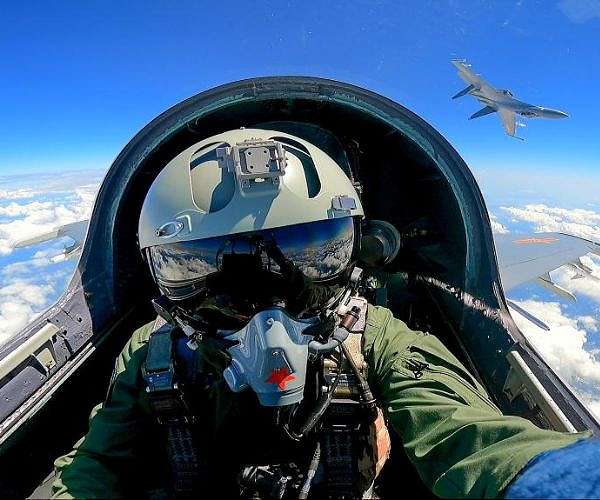
More than 20 Chinese warplanes were detected around Taiwan, with 11 crossing a sensitive median line separating the self-ruled island from China, Taipei's defence ministry said Thursday, the first significant show of force since the weekend's presidential election.
The ministry, which releases data daily on the Chinese military presence around Taiwan, said Thursday that 24 warplanes and 5 ships had been detected in the 24 hours leading up to 6 am (2200 GMT).
"11 of the detected aircraft had crossed the median line of the Taiwan Strait or entered Taiwan's southwest and north (air defence identification zone)," the ministry said in a statement.
Democratic Taiwan has its own government, military and currency — but China claims it as its territory and has never renounced the use of force to bring it under its control.
Saturday's election was won by the Democratic Progressive Party's Lai Ching-te, who China regards as a "separatist". Beijing warned ahead of voting day that his win would bring "war and decline" to Taiwan.
China — which maintains a near-daily military presence around Taiwan — did not send an outsized number of warplanes and naval vessels in the election's immediate aftermath.
But it drew first blood in the political sphere, with Pacific nation Nauru abruptly announcing Monday it would switch diplomatic recognition from Taiwan to China, leaving Taipei with just 12 countries or states that still do.
The largest number of warplanes China has sent during a 24-hour window came in September, when Taiwan detected 103 Chinese aircraft around the island. Forty of them crossed the median line.
The constant stream of Chinese warplanes and naval vessels around Taiwan represents a "grey zone" tactic that stops short of an outright act of war, conflict experts say.
China, Philippines agree to talk more on South China Sea flare-ups
Beijing (AFP) Jan 18, 2024 –
Chinese and Philippine officials have agreed on the need for closer dialogue to deal with "maritime emergencies" in the South China Sea, including in the hotly contested Second Thomas Shoal, Beijing said.
Manila and Beijing have a long history of maritime territorial disputes in the waterway, but relations sharply deteriorated recently over a series of incidents involving vessels from both countries.
Confrontations were among their most intense around the Second Thomas Shoal, which Beijing calls the Ren'ai Shoal, where Manila has stationed a grounded naval vessel to assert its territorial claims.
Following weeks of tensions, both sides on Wednesday held their 8th Bilateral Consultation Mechanism on the South China Sea in Shanghai, they said in a pair of statements.
Beijing said the two countries held a "candid and in-depth exchange of views" on the situation in the South China Sea, which it claims almost in its entirety despite an international tribunal ruling that its assertions have no legal basis.
Both sides agreed "that maintaining communication and dialogue is essential to maintaining maritime peace and stability", China's foreign ministry said in a readout.
And they said they would work to improve their "maritime communication mechanism", Beijing added, in a bid to "properly handle maritime emergencies, especially the situation on the Ren'ai Shoal".
Manila, in turn, said the two countries "agreed that continuous dialogue is important to keep peace and stability at sea" and "assured each other of their mutual commitment to avoid escalation of tensions".
"The two sides had frank and productive discussions to de-escalate the situation in the South China Sea and both sides agreed to calmly deal with incidents, if any, through diplomacy," its foreign ministry said in a statement.
This month, China held military drills in the South China Sea as the United States and the Philippines conducted their own joint exercises in the same waters.
The drills followed a month of tense standoffs between China and the Philippines in disputed reefs in the area that saw a collision between vessels from the two countries and Chinese ships blasting water cannon at Philippine boats.
