
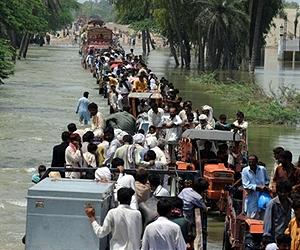
About 166,000 people are still displaced six months after devastating floods swept away homes and drowned livestock in Pakistan, the UN refugees agency said Tuesday.
"Six months after devastating floods first hit Pakistan in July 2010, some 166,000 people are still displaced and living in over 240 camps and spontaneous settlements," said Andrej Mahecic, spokesman for the UN High Commissioner for Refugees.
"This is substantially down from the peak levels in September and October when 3.278 million people were living in camps, but it still represents a substantial population in need of help," he added.
Most of those who are still homeless are located in the southern province of Sindh, one of the hardest hit districts by the flood.
About 20 million people were affected in the natural disaster and 1.7 million houses were damaged or destroyed, said the UNHCR.
The flood also wiped out more than 2.2 million hectares of arable land, depriving rural communities of food and resources, said the Red Cross.
earlier related report
'Rogue' storm blamed in Pakistan flooding
Seattle (UPI) Jan 25, 2011 –
U.S. scientists say a "rogue" weather system caused the disastrous Pakistan floods of last summer that killed more than 2,000 people and left millions homeless.
Researchers at the University of Washington say a system that wandered hundreds of miles farther west than is normal for such systems was responsible, a university release reported Tuesday.
The flooding that began in July and at one point covered an estimated 20 percent of Pakistan's total land area in water was caused by a storm system that had formed over the Bay of Bengal in late July and moved unusually far to the west over the Himalayas, dumping rainfall that caused the Indus River in Pakistan to overflow.
UW researchers examined rainfall data from satellites.
"We looked through 10 years of data from the satellite and we just never saw anything like this," UW atmospheric sciences professors Robert Houze said.
"I think this was a rare event, but it is one you want to be thinking about," Houze said. "Understanding what happened could lead to better predictions of such disasters in the future."
Share This Article With Planet Earth
