
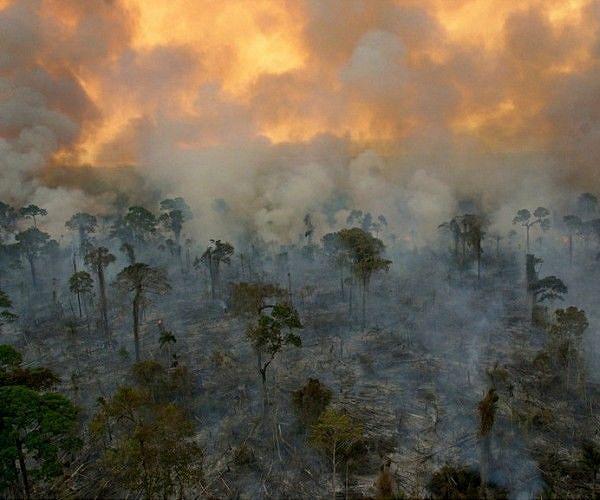
Lieutenant Silva's face is grim as he watches his firefighters try — and fail — to control one of the thousands of wildfires ravaging Brazil's Pantanal, the world's biggest tropical wetlands.
"It needs to rain. We've got low moisture, intense heat. With that combination, rain is our only hope," says Silva, even as new flames break out at the spot his team of six firefighters is trying to douse on the grounds of an ecotourism hotel in the northern Pantanal.
Even when the fire looks to be out, embers continue burning underground, feeding on layers of dry leaves that have accumulated amid the region's worst drought in nearly five decades.
The firefighters advance about 60 meters (yards) into a dense patch of charred scrubland, but the hoses connected to their truck can reach no farther.
One starts using a leaf blower to clear away the dead vegetation, which momentarily extinguishes the flames on the surface.
But the slightest gust of wind is enough to reignite them.
Silva decides to retreat and change tactics: better to create a fire break by soaking the ground around the truck in water.
The firefighters hope that will prevent the flames from reaching the other side, where there is a still intact hill of native vegetation inhabited by jaguars.
The Pantanal sits at the southern edge of the Amazon rainforest, stretching from Brazil into Bolivia and Paraguay.
The region is known for its lush landscapes and biodiversity.
But this year, some 23,500 square kilometers (9,000 square miles) of the wetlands have gone up in smoke — nearly 12 percent of the Pantanal.
Helped by local volunteers, firefighters are racing to control the flames before they destroy the area's hotels and numerous wooden bridges, essential infrastructure for getting in and out of a region normally covered in water this time of year.
Hotel worker Antonio da Silva is one of the volunteers helping safeguard the bridges, wearing a cowboy hat and face mask.
"I'm from this region, I've lived in the Pantanal for 60 years, and I've never seen anything like this," he says.
World lost 100 million hectares of forest in two decades: UN
Paris (AFP) Sept 15, 2020 –
The world has lost nearly 100 million hectares of forests in two decades, marking a steady decline though at a slower pace than before, a UN agency reported Tuesday.
The proportion of forest to total land area fell from 31.9 percent in 2000 to 31.2 percent in 2020, now some 4.1 billion hectares, according to the Food and Agriculture Organization.
It marks "a net loss of almost 100 million hectares of the world's forests," the FAO said.
Deforestation has hit particularly hard sub-Saharan Africa and southeast Asia, where it has accelerated in the last decade, but also Latin and Central America, where it has nonetheless slowed down.
Forests are being cut down mainly to make way for crops or farm animals, especially in less developed countries.
In southeast Asia, forest now covers 47.8 percent of the land compared to 49 percent in 2015. In sub-Saharan Africa, it covers 27.8 percent compared to 28.7 percent five years ago.
In Indonesia, it is 50.9 percent, down from 52.5 percent. In Malaysia, it is 58.2 percent, down from 59.2 percent five years ago.
A country strongly focused on agriculture like the Ivory Coast has seen forests reduced to 8.9 percent of the total land area from 10.7 percent in 2015. Kenya, Mali and Rwanda have largely held firm against forest loss.
In Latin and Central America, forest covers only 46.7 percent of the total land, compared to 47.4 percent five years ago.
In Brazil, forests declined to 59.4 percent of the country's territory in 2020 from 60.3 percent in 2015. In Haiti, deforestation has continued apace — falling to 12.6 percent of the total land area from 13.2 percent in 2015.
In contrast, in many parts of Asia, Europe and North America forest area has increased or stayed the same in the last five years with policies to restore woodland and allow forests to expand naturally.
In China, forests make up 23.3 percent, up from 22.3 percent in 2015. In Japan, they account for 68.4 percent, the same as it was five years ago.
In France, forests cover 31.5 percent of the land in 2020, up from 30.7 percent in 2015. In Italy, they make up 32.5 percent of the national territory, up from 31.6 five years ago.
In Britain, they make up 13.2 percent, up from 13 percent five years ago.
In Canada, it is unchanged at 38.2 percent, and in the United States, unchanged at 33.9 percent.
In Australia the figure rose from 17.3 to 17.4 percent and in New Zealand from 37.4 percent to 37.6 percent over the five years.
