
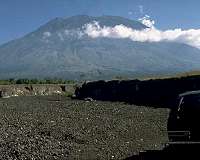
Plumes of ash from a rumbling volcano forced Indonesian authorities to close Bali's airport for a second day Tuesday, as a threatened eruption stranded tourists and forced mass evacuations.
Tens of thousands of frightened people have fled their homes near Mount Agung, which looms over the resort island, as experts raised the alert level to maximum and warned it could erupt at any moment.
Towering columns of thick grey smoke have been belching from the volcano since last week, and in the last few days have begun shooting into the sky, forcing all flights to be grounded until at least Wednesday morning.
"The Volcanic Ash Advisory shows that the plane routes have been covered by volcanic ash, this is dangerous for the flights," Wisnu Darjono from the air traffic agency AirNav official said, referring to a global network of experts that supplies volcano-related information.
Some 40,000 people have abandoned their homes in the danger zone but as many as many as 100,000 will likely be forced to leave, disaster agency officials have said.
"Volcanic ash is still spewing. It's thick and rising very high — up to three or four kilometres from the crater," said I Gede Suantika, an official at Indonesia's volcanology agency.
"Activity at Mount Agung remains very high. It's still on the highest alert level," he added.
The exclusion zone around Agung, which is 75 kilometres away from the beachside tourist hub of Kuta, has also been widened to 10 kilometres.
As of Tuesday some 443 flights had been cancelled, affecting more than 120,000 passengers in Bali, a top holiday destination that attracts millions of foreign tourists every year.
The airport on nearby Lombok island — also a popular tourist destination east of Bali — has opened and closed several times in the past few days. It is currently open but may yet be shuttered again, officials said.
– Memories of disaster –
Mount Agung last went off in 1963, killing some 1,600 people in one of the deadliest eruptions ever seen in a country with nearly 130 active volcanoes.
Memories of that disaster have helped drive people towards community centres and makeshift camps, including villagers who have to leave precious livestock behind.
"I am very worried because I have experienced this before," 67-year-old Dewa Gede Subagia, who was a teenager when Agung last roared, told AFP from one evacuation centre.
"I hope this time I won't have to evacuate for too long. In 1963, I left for four months."
Experts said however that Agung's recent activity matches the build-up to that disaster, which ejected enough debris — about a billion tonnes — to lower global average temperatures by 0.2 – 0.3 degrees Celsius for about a year.
"What we are seeing at the moment are small explosions, throwing out hot gases and fragments of molten rock, or ash," said David Pyle, a volcano expert at Oxford University.
"The probability of a large eruption is high, but this may take some days or weeks to unfold."
Agung rumbled back to life in September, forcing the evacuation of 140,000 people living nearby. Its activity decreased in late October and many returned to their homes.
However, on Saturday the mountain sent smoke up into the air for the second time in a week in what volcanologists call a phreatic eruption — caused by the heating and expansion of groundwater.
Then on Monday so-called cold lava flows appeared — similar to mud flows and often a prelude to the blazing orange lava seen in many volcanic eruptions.
Thousands flee as Bali raises volcano alert to highest level
Karangasem, Indonesia (AFP) Nov 27, 2017 –
A rumbling volcano on Bali could erupt at any moment, authorities warned Monday as they raised alert levels to maximum, accelerated a mass evacuation and closed the main airport, leaving thousands of tourists stranded on the Indonesian resort island.
Massive columns of thick grey smoke that have been belching from Mount Agung since last week have now begun shooting more than three kilometres (two miles) into the sky, forcing hundreds of flights to be grounded.
Some 40,000 frightened people have fled their homes around the volcano but as many as 100,000 will likely be forced to leave, disaster agency officials said, after raising the alert to its highest level.
The exclusion zone around Agung, which is 75 kilometres (47 miles) from the beachside tourist hub of Kuta, has also been widened to 10 kilometres.
Makeshift tents and community centres filled up Monday as nearly two dozen villages were emptied of their inhabitants, including farmers reluctant to leave precious livestock behind.
"Continuous ash puffs are sometimes accompanied by explosive eruptions and a weak booming sound," the National Board for Disaster Management said earlier Monday.
"The rays of fire are increasingly observed at night. This indicates the potential for a larger eruption is imminent."
Agung rumbled back to life in September, forcing the evacuation of 140,000 people living nearby. Its activity decreased in late October and many returned to their homes.
However, on Saturday the mountain sent smoke up into the air for the second time in a week in what volcanologists call a phreatic eruption — caused by the heating and expansion of groundwater.
Then on Monday so-called cold lava flows appeared — similar to mud flows and often a prelude to the blazing orange lava seen in many volcanic eruptions.
"I'm very concerned because I left my house behind and I'm also worried about family," said 36-year-old farmer Putu Suyasa, who fled with some relatives from a village eight kilometres away from the volcano.
"The mountain is spewing thicker smoke than before."
– Scary memories –
Dewa Gede Subagia was a teenager when Agung last roared.
"I am very worried because I have experienced this before," the now 67-year-old told AFP from one evacuation centre.
"I hope this time I won't have to evacuate for too long. In 1963, I left for four months."
Mt. Agung last went off in 1963, killing around 1,600 people in one of the deadliest eruptions ever seen in a country with nearly 130 active volcanoes.
The airport in Bali's capital Denpasar, a top holiday destination that attracts millions of foreign tourists every year, has been closed.
Some 445 flights were cancelled, affecting more than 59,000 passengers, officials said.
Colin Cavy, a French dive-master who has been in Indonesia for a couple of months, was nervously looking at his now-expired visitor visa.
"I need to go to the immigration office," he said.
While there was dismay from some tourists who were unable to return to their homes and jobs, others took events in their stride.
"What can I say? We have to cooperate because this is a natural disaster," said Indian visitor Krisna Mustafa.
Many were told that it could be several days before they could leave.
"My 7:00 am flight this morning got cancelled, just when we were about to board," said 23-year-old Indonesian tourist Merry Handayani Tumanggor.
"Now we have to stay in Bali again — the earliest we can go is on Friday, they say."
The airport on nearby Lombok island east of Bali, also a popular tourist destination, was closed for a night on Sunday but reopened on Monday morning.
Officials announced late Monday that Lombok airport has been closed again until Tuesday morning due to the volcanic ash and at least 47 flights to and from the island have been cancelled.
The Australian government put out a travel advisory on Sunday, warning that volcanic activity "may escalate with little or no notice".
"Past eruptions of Mount Agung have shown this volcano's potential to cause significant impacts," it added.
– Prayers –
Dozens of Balinese Hindus took part in ceremonies near the volcano on Sunday, offering prayers in the hope of preventing an eruption.
Officials have said the activity could be a magmatic eruption — one which involves the decompression of gas and results in the spewing of ash — and advised people near the mountain to wear masks.
Indonesia is the world's most active volcanic region. The archipelago nation with over 17,000 islands lies on the Pacific "Ring of Fire" where tectonic plates collide, causing frequent volcanic and seismic activities.
Last year, seven were killed after Mt. Sinabung on the western island of Sumatra erupted, while 16 were left dead by a Sinabung eruption in 2014.
Thousands flee as Bali raises volcano alert to highest level
A rumbling volcano on the resort island of Bali could erupt at any moment, authorities warned Monday as they raised alert levels to maximum, accelerated a mass evacuation and closed the main airport, leaving tourists stranded.
Massive columns of thick grey smoke that have been belching from Mount Agung since last week hae now begun shooting more than three kilometres (two miles) into the sky … read more
