
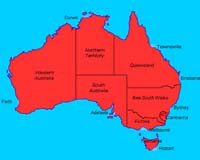
Australia warned Thursday it could face 6,000 swine flu deaths this year in a "worst-case scenario", as nervous governments tried to curb the pandemic and keep tabs on potentially risky public events.
The gloomy projection came as the number of A(H1N1) infections grew around the world, with Canada saying more than 200 school children had contracted the virus at summer camp.
Australian Health Minister Nicola Roxon stressed that the number of deaths was likely to be lower than the "worst-case" projection, which was based on an assumption of a lack of vaccines and anti-viral drugs.
"We could expect around 6,000 deaths across the country," she told ABC radio.
"That's really the worst-case scenario that is being projected at the moment."
Australia — the Asia-Pacific nation worst-hit by the pandemic, with 11,194 infections, or nearly 12 percent of the global total of 94,500 confirmed by the World Health Organization — is planning a mass vaccination scheme in October.
WHO chief Margaret Chan warned on Wednesday that a vaccine to combat the surging pandemic would not be readily available for months.
In South America, site of some of the highest infection rates, health ministers from six countries met in Buenos Aires to coordinate defences against the virus.
The ministers from Argentina, Bolivia, Brazil, Chile, Paraguay and Uruguay expressed alarm at the momentum the A(H1N1) virus has picked up in the southern hemisphere's winter.
Argentina has reported 137 swine flu deaths and more than 3,000 infections, giving it the worst fatality toll in the world after the United States, where 211 deaths and some 37,000 infections have been recorded.
The WHO has reported about 430 deaths worldwide.
Uruguay's president, Tabare Vazquez, said Wednesday that swine flu appeared "more benign" than run-of-the-mill seasonal flu, which kills tens of thousands every year. But Chilean President Michelle Bachelet said the flu outbreak was the "worst in 50 years."
In Canada, which has seen 25 swine flu deaths, according to WHO figures, hundreds of school kids contracted the virus at three summer camps in the eastern province of Ontario, local health authorities said.
"The total number of campers combined among these three camps that are affected is 227 ill out of a total of 1,275 campers," local health official Charles Gardner told broadcaster NBC.
"They're not severe, I would say, certainly none have required hospitalisation."
Elsewhere officials were closely monitoring sports and entertainment events after South Korea scrapped several gatherings when more than a dozen Indonesians attending a choir contest there tested positive for the virus.
In rugby-mad New Zealand, officials urged fans to stay away from the Tri-Nations rugby Test against Australia if they had swine flu symptoms.
"If you have symptoms, don't go — you might feel well enough, but be considerate to everyone else," deputy public health director Fran McGrath told the New Zealand Herald.
In one unusual measure, a British bishop advised churches to ban holy water as part of hygiene efforts.
"Some churches have a stoup for holy water near the entrance to the church door and people are invited to dip a finger in this, and to make the sign of the cross.
"The water contained in stoups can easily become a source of infection and a means of rapidly spreading the virus," said the Bishop of Chelmsford, John Gladwin. "This practice should be suspended" in Chelmsford diocese.
He also urged caution when taking Holy Communion, warning if anyone had flu-like symptoms, the "priest alone should drink wine from the chalice."
Britain is Europe's worst hit country, with 17 people dying after contracting swine flu.
burs-njc/sst
Share This Article With Planet Earth
