
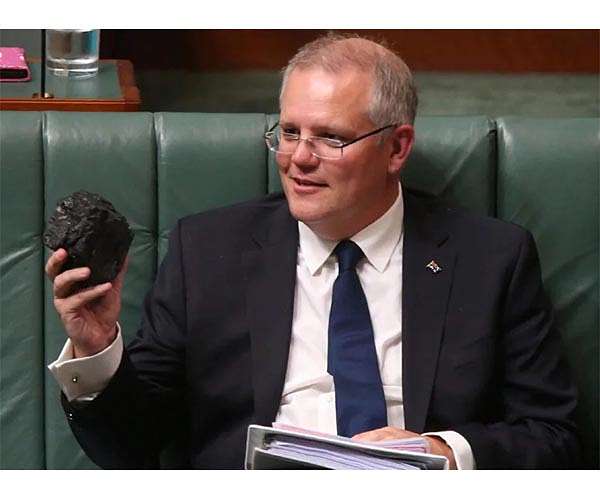
Australian Prime Minister Scott Morrison, under pressure to adopt a 2050 net-zero carbon emissions target, said in an interview published Monday that he may not join this year's landmark UN climate summit in Glasgow.
The world's biggest coal exporter by value, and still reliant on fossil fuels for most of its electricity, Australia has not made a firm commitment on its own greenhouse gas reductions.
Morrison has vowed to mine and export fossil fuels as long as there are buyers.
Asked about attending the global climate crisis conference in November, Morrison told the West Australian newspaper: "We have not made any final decisions".
"I mean it is another trip overseas and I have been on several this year and spent a lot of time in quarantine," he was quoted as saying.
"I have to focus on things here and with Covid. Australia will be opening up around that time. There will be a lot of issues to manage and I have to manage those competing demands."
The 12-day meeting in Scotland, the biggest climate conference since landmark talks in Paris in 2015, is seen as a crucial step in setting worldwide emissions targets to slow global warming.
Foreign Minister Marise Payne said Australia would be "strongly represented" at a senior level, even if Morrison did not attend the summit.
Morrison's government has suggested it will achieve net-zero carbon emissions "as soon as possible", and preferably by 2050, but has not made any commitments to do so.
The Australian prime minister told the newspaper he was trying to bring the government and the country together on commitments, to provide certainty for the next 20-30 years.
He has been in tough negotiations over setting a net-zero target within the conservative coalition government, an alliance of his own Liberal Party and the Nationals, who have much of their support base in rural and mining communities.
Climate scientists warn extreme weather and fierce fires will become increasingly common due to manmade global warming.
Environmentalists argue inaction on climate change could cost Australia's economy billions of dollars as the country suffers more intense bushfires, storms and floods.
Asked if he would commit to a specific climate target, in a separate interview with The Australian newspaper, the prime minister replied: "I can assure you we will have a plan".
Morrison told the newspaper that Australia's position as the primary energy exporter in the Asia-Pacific region would change and it was important to make a transition towards a low-emission economy.
But the prime minister added that the change had to be managed so "things keep running, things stay open, things keep getting dug out of the ground for some considerable time, you have to keep making stuff, you have to keep eating things and the world needs food".
Vanuatu fights to take climate crisis to top UN court
Sydney (AFP) Sept 24, 2021 –
The tiny low-lying Pacific island of Vanuatu said Saturday it will lead a global campaign to get a landmark legal opinion from the UN's top court on the consequences of global warming.
Announced in the run-up to a major UN climate summit in Glasgow in November, the goal is to get one of the world's highest judicial authorities to weigh in on the climate crisis.
Though a legal opinion by the court would not be binding, Vanuatu hopes it would shape international law for generations to come on the damage, loss and human rights implications of climate change.
But no single state can request such an opinion from the International Court of Justice in The Hague.
Instead, the island of some 300,000 people will try to sway other countries to vote for the move, targeting the next UN General Assembly in September 2022, Vanuatu government spokesman Yvon Basil told AFP.
Vanuatu, which has been hit by two category five cyclones in the past five years and is surrounded by rising seas lapping its shores, said it would coordinate efforts by other Pacific island countries and like-minded nations.
"Stories of devastation arising from climate-related events are no longer exceptional," the government said in a statement.
"Rather, they are rapidly becoming the new normal in all island nations, and in other countries and regions," it said.
A youth-led Pacific organisation that has been campaigning for climate change to be referred to the UN court welcomed Vanuatu's announcement.
"For the sake of Pacific peoples and other front-line communities, we must address the crisis," Caleb Pollard, president of Pacific Islands Students Fighting Climate Change, said in a statement.
