
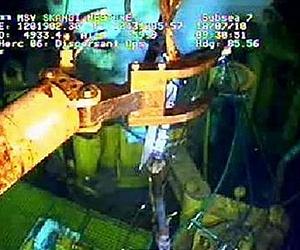
BP engineers used underwater robots Sunday to replace a cap over a gushing oil well in the Gulf of Mexico in a new attempt to contain the worst environmental disaster in US history.
The old cap loosely covering the well was removed by the robots on Saturday as the first step in the operation.
A fleet of about 400 skimmers crowded around the well site to boost shoreline defense during the complex operation, said oil giant BP, which is struggling to end the damaging spill.
"Over the next four to seven days, depending on how things go, we should get that sealing cap on. That's our plan," BP senior vice president Kent Wells told reporters.
"We've been 24/7 since the beginning and that will continue until the end," he said Saturday.
The cap aims to provide a temporary solution to the devastating leak triggered after the BP-leased Deepwater-Horizon rig exploded and sank nearly three months ago.
About 35,000 to 60,000 barrels of oil (1.5 million to 2.5 million gallons) has been gushing out of the ruptured well each day, and the current containment system captures around 25,000 barrels every 24 hours.
BP says the new cap and the deployment of the Helix Producer containment ship will raise the capture to 60,000 to 80,000 barrels (2.5 million to 3.4 million gallons) a day — in effect halting the leak that has imperiled wildlife and livelihoods across the Gulf Coast.
It warned however: "This new sealing cap has not been deployed at these depths or under these conditions, and there can be no assurance that the sealing cap will be successfully installed or installed within the anticipated timeframe."
No permanent solution is expected until the first of two relief wells is completed in order to inject drilling fluids into the gushing well and then seal it with cement.
BP engineers manipulated the undersea robots nearly a mile (1,600 meters) below the surface, rushing to take advantage of about a week of expected favorable weather conditions in the spill area.
Following the removal of the cap, a subsea dispersant wand was inserted into the riser, officials said. Two plugs and all six flange bolts were then removed.
The engineers next worked on removing the flange, a rib-like assembly that must be taken out in order to install another piece of equipment — known as a flanged spool — over the drill pipe and connect it to the new containment dome.
After the spool is in place, the new cap can be positioned. The cap will allow new connections to collect oil and also has valves that can control the flow of oil.
Wells said the Helix Producer container ship was meanwhile undergoing final tests and should begin capturing some of the leaking oil from the well on Sunday.
"We expect it to start ramping up collection tomorrow and it'll ramp up probably over a three-day period to get up to its full capacity," he said.
A containment ship that was connected to the old cap, the Discovery Enterprise, has been removed but will return once the new cap is in place.
A third ship, the Q4000, was expected to continue siphoning up some 8,000 barrels a day during the installation of the new containment device.
The existing cap, installed over a month ago, allowed some oil to continue escaping because it was fitted loosely over a jagged well pipe.
About 2.1 to 4.1 million barrels of oil have spilled into the Gulf waters and experts warn it will be years, if not decades, before it stops washing up on shore.
Sunday's operation is the latest in a series of efforts to stop oil gushing from the well.
In early May a large collection dome was put in place but became clogged with gas hydrates.
Later a "top kill" effort to plug the well with drilling mud failed when the upward force of gas and oil became too great to overcome.
Oil has washed up on beaches in all five Gulf states — Texas, Louisiana, Mississippi, Alabama and Florida — forcing fishing grounds to be closed and threatening scores of coastal communities with financial ruin.
Share This Article With Planet Earth
