
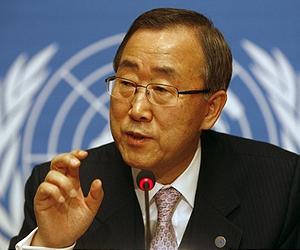
UN leader Ban Ki-moon said Saturday he has given up hope of holding a conference on a nuclear weapons-free zone in the Middle East this year, but still hopes it can be held in 2013.
Ban and Finnish special envoy Jaakko Laajava have been trying to persuade Middle East powers to attend the conference but hit opposition from Israel and others.
The conference, organized by the United States, Britain and Russia, was to be held in 2012 in Finland. But Ban said he was now aiming for it "to be convened at the earliest opportunity in 2013."
The US State Department said on Friday that the conference could "not be convened because of present conditions in the Middle East and the fact that states in the region have not reached agreement on acceptable conditions for a conference."
"The United States believes that a deep conceptual gap persists in the region on approaches toward regional security and arms control arrangements," said a State Department statement.
But Britain said the three co-organizers also wanted it held as soon as possible in 2013.
Ban also appealed to Middle East states to overcome their differences "to seize this rare opportunity to initiate a process that entails direct engagement on security issues — a critical shortcoming at the moment — and follow-on steps leading to achieving the complete elimination of all weapons of mass destruction in the region, nuclear, chemical and biological and their delivery systems."
"I reaffirm my firm resolve and commitment together with the Russian Federation, the United Kingdom and the United States, in consultation with the states of the region, to convene a conference," Ban said.
Laajava will continue talks "in the shortest possible time which will allow the conference to be convened at the earliest opportunity in 2013," Ban said.
Israel had said it would not attend a conference now because of the tense security in the region and it would become a target of diplomatic attacks in any talks, diplomats said.
US diplomats had expressed similar fears, which have heightened since the eight days of conflict between Israel and the Hamas movement in Gaza this month.
Iran and Arab states criticize Israel for its suspected nuclear arsenal. Israel refuses to say whether it has nuclear arms, though security experts say it has a substantial number of weapons.
Israel and the United States and its allies say Iran is the main proliferation threat, even though Iran denies seeking nuclear weapons.
A conference on the creation of a weapons of mass destruction-free Middle East was called for at a May 2010 conference to review the 1970 nuclear Non-Proliferation Treaty.
