
In a makeshift shelter on the campus of North Carolina State University, hundreds of people who fled Hurricane Florence dream of going home, but have little idea about when that will happen, or if their homes survived the deluge.
"Everybody wants to go home," said Dianna van Horne, a Red Cross worker helping some of the hundreds of thousands of Americans driven to this shelter near the state capital Raleigh by the torrential rains and storm surge that devastated the coast.
Four-month-old Genesis, sleeping peacefully in the arms of her mother Rashaunda Dickens, was oblivious to the 300 or so other people living in cramped conditions here.
Dickens left her home in the seaside town of Morehead City on Tuesday with her four children, just one step ahead of the storm.
"The house that we were living in, the water came up to second floor, so we lost everything," she said. "The kids are scared. They don't really understand what's going on."
Her eldest son Jeremy said he can't wait to get back to school and his normal life. "It's so loud in the room, everybody is snoring when I'm trying to sleep. And the beds are hard."
Thomas Hammett has two tears tattooed by the corner of his left eye, which had probably never expressed better how his feels than right now.
He fled his home in Otway with his two kids, Christopher, aged three, and Jerry, 11.
"We can't wait to go back home and live a normal life again, hopefully on Wednesday," Hammett said.
"We had to evacuate, it was too dangerous to stay. Some people have died down there. The neighbors told us our home was fine apart from a few branches down, so that's a relief at least."
– 'We are all equal' –
The fire alarm in the university's Friday Institute — more used to academic conventions than huddled refugees — went off in the early hours of the morning, forcing the huddled residents into the rain in their pyjamas, before joining the breakfast line.
Despite their tribulations, most are doing their best to stay positive.
"Everyone has been very nice, very helpful," said David Owens, a wheelchair-bound pensioner who had been through three other shelters before arriving in Raleigh, after a journey of some 500 miles (800 kilometers).
"There are some very interesting people here to talk to, with stories that will humble you and make your heart cry," he said.
Van Horne, the Red Cross official, said that despite their yearning to go home, the displaced people "are in a safe place and are making new friends."
"Black, white, Hispanic people… we all come together here. We got on the same bus, we smell, we sweat, we are all equal," said Charles Williams, an African American ex-sailor.
"Whether you make $20,000 or 200,000 a year, all the money you have won't do you any good. All that matters is we're all safe."
Florence death toll rises to 23 in Carolinas
Fayetteville, United States (AFP) Sept 17, 2018 –
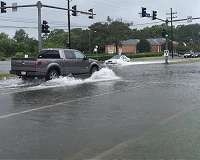
The death toll from Hurricane Florence rose to 23 in the Carolinas on Monday as many low-lying neighborhoods remained under water and a flood warning was issued for others as rivers continued to rise amid pelting rain.
A tornado watch was issued for parts of North and South Carolina as emergency management officials also warned of the potential for dam failures and landslides.
"This is an epic storm that is still continuing," North Carolina Governor Roy Cooper said at a press conference. "This is a monumental disaster for our state."
Cooper said there have been 17 confirmed storm-related deaths in North Carolina from Florence, which made landfall on the state's Atlantic coast on Friday as a Category 1 hurricane. "We hope there are not more," Cooper said.
At least six deaths have been confirmed in neighboring South Carolina with the latest being the driver of a pickup truck who drove into standing water in Lexington County.
More than a dozen rivers across North Carolina were at major flood stage on Monday or threatening to rise to critical levels.
"River flooding is dynamic and it's happening all over our state," Cooper said.
"Many roads in our state are still at risk of floods," he said, warning people who have been evacuated not to return home yet and not to go out if they do not need to. "Please don't make yourself someone who needs to be rescued," he said.
Wilmington, on the banks of the Cape Fear River in North Carolina, was almost completely cut off by land but emergency management teams managed to truck food and water overnight into the port city of 120,000 people.
North Carolina emergency response department officials said that 23 truckloads of Meals, Ready to Eat — packaged US military rations — and crates of bottled water had been sent into Wilmington.
"We're dealing with some very, very tough situations with respect to the impassable roads coming into the city of Wilmington," Mayor Bill Saffo told residents on Twitter. "As the water recedes things will get better.
"We're going to be OK," Saffo said. "We're going to get through this."
– Flash flood warning –
In Fayetteville, the Cape Fear River was expected to reach major flood stage at 58 feet (17.6 meters) on Monday and hit nearly 62 feet (18.9 meters) on Tuesday before receding.
The Deep River at Ramseur was slightly above major flood stage at 25.5 feet (7.8 meters).
"It's worrying to watch the water slowly rising," said Denise Harper, a resident of Grifton, another small North Carolina town threatened by rising water in a nearby creek and the Neuse River.
"A lot of people have evacuated already," Harper said.
More than half a million people in the Carolinas remained without electricity on Monday, according to emergency officials.
The National Hurricane Center (NHC) warned that Florence, which has been downgraded to a tropical depression, continues to dump heavy rain on parts of North Carolina and northeastern South Carolina.
"Flash flooding will continue over portions of the western mid-Atlantic regions," the NHC said.
The National Weather Service said there is an "elevated risk for landslides" in North Carolina.
North Carolina officials said there has been a small dam breach that did not cause any significant damage and they were monitoring other structures closely.
Numerous roads across eastern North Carolina were blocked by fallen trees and flooding including parts of I-95, a major north-south artery.
Secretary of Homeland Security Kirstjen Nielsen announced meanwhile that she plans to visit North Carolina on Monday to discuss the response and recovery efforts and tour flood-affected areas.
President Donald Trump has also announced plans to visit the flood-hit region this week but a date has not yet been set.
"We're going to need significant resources to recover," Cooper, the North Carolina governor, said.
