
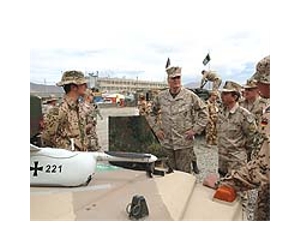
The German government is under increasing pressure to justify the military mission in Afghanistan mission, where seven German troops have been killed in two weeks.
As NATO forces are waging war on the Taliban in Afghanistan's south, the insurgents put increasing pressure on Western troops in the country's northern provinces.
Germany has nearly 5,000 soldiers in Mazar-i-Sharif and Kunduz, where they face an increasing number of ambushes, firefights, rocket attacks and suicide bombings.
Four Germans were killed and five wounded Thursday when a rocket-propelled grenade hit an armored vehicle in Baghlan province near Kunduz. This pushes the number of German casualties in Afghanistan to 43.
The attack — the worst on German troops since 2003 — happened shortly before German Defense Minister Karl Theodor zu Guttenberg left Afghanistan after an unannounced visit. It comes less than two weeks after three German soldiers died in a firefight with Taliban insurgents near Kunduz, and as support for the mission is waning at home.
A recent poll published by German news magazine Stern indicates that 64 percent of Germans asked said they were in favor of returning the troops home — the highest percentage ever.
The German presence has come under additional pressure since a controversial German-ordered air raid that killed more than 140 people, most of them Afghan civilians, near Kunduz last September.
Germans were largely supportive of the Afghanistan mission in the early years, when it had a clear humanitarian focus. Yet the once peaceful north has turned into Taliban territory and the German casualties have been rising.
Berlin has, during the past years, shied from communicating the mission's shifting focus; it wasn't until the Taliban ambush two weeks ago that a German government official spoke of war in Afghanistan.
"The perfidy and the complexity" of the attack and the overall security situation in Afghanistan show that Germany is involved "in what might colloquially be called a war," said zu Guttenberg.
The defense minister Thursday announced he would deploy heavy attack equipment, including self-propelled artillery weapons, to Afghanistan to protect the troops — a sign that security in Afghanistan won't improve anytime soon.
German Chancellor Angela Merkel stands behind the mission but if the upsurge in bloodshed continues, public opinion on Afghanistan may break her government.
The collapse of the pro-Afghanistan Dutch government in February was a major setback for the U.S.-led NATO mission — the 1,900 Dutch troops stationed in Uruzgan province, where they fight Taliban insurgents and lead local reconstruction efforts, such as training police, building roads and schools, are due for withdrawal this summer.
The Germans are the third-largest Western force in Afghanistan behind the United States and Britain and a key stabilizing factor in the north. Losing them as well could spell disaster for the mission, observers say.
earlier related report
Germany boosts firepower of Afghan troops
Berlin (UPI) Apr 15, 2010 –
The German government has reacted to criticism of the armament of its troops in Afghanistan by deciding to dispatch heavy firepower there.
German Defense Minister Karl Theodor zu Guttenberg said he would "as quickly as possible" send to Afghanistan two models of the Panzerhaubitze 2000, a world-leading self-propelled artillery weapon developed by Krauss-Maffei Wegmann and Rheinmetall. While Dutch forces in Afghanistan regularly use the howitzers with a target range of up to 37 miles, the Germans don't have a single one in Afghanistan.
Sending howitzers is a major policy reversal for Berlin, which has shied from deploying heavy attack equipment into Afghanistan out of fear it would point to a war-like mission — highly unpopular in largely pacifist Germany.
The German troops will also receive TOW anti-tank guided missiles and additional Marder infantry fighting vehicles, German news magazine Der Spiegel reports.
"Those are basic conditions that will be created to meet the mission's challenges," the defense minister said.
The announcement came shortly before four German troops were killed in a Taliban ambush Thursday, handing critics of the mission even more arguments after three troops were killed in a similar attack two weeks ago.
Thursday's attack underlined the need for greater protection from large-scale attacks. Taliban insurgents used a rocket-propelled grenade to stop an Eagle IV armored vehicle patrolling near Baghlan, south of Kunduz. A heavy firefight ensued, German daily Bild reports. In addition to the four deaths, five Germans were seriously injured.
The firefight two weeks ago was a militarily executed ambush from two sides involving some 80 insurgents, which shows that the Taliban are operating more professionally when facing NATO troops.
This has prompted German officials to call for key defense equipment such as transport planes, helicopters, mortar and heavy armored vehicles, to be deployed to Afghanistan.
Some experts have even called for the Leopard 2 tank, produced by Germany's Krauss-Maffei Wegmann, a 60-ton war machine already used by Canadian and Dutch troops.
Zu Guttenberg said he wouldn't deploy Leopard 2 tanks, because they aren't suited for the difficult terrain around Kunduz. He added, however, that additional improvements would be made to military equipment for the nearly 5,000 German troops in Afghanistan. While he didn't specify, observers expect this to concern ammunition.
A classified Bundeswehr report, written by a German general and leaked to German newspaper Bild, calls for stronger ammunition for the Heckler & Koch G36, a standard Bundeswehr assault rifle. Similar concerns relate to cannons mounted on the armored vehicles Dingo and Fox.
Germany is Europe's largest weapons exporter. Its domestic industry is building world-class armored vehicles, artillery and submarines.
It is involved in several large multinational defense projects, such as the Eurofighter jet, the Airbus A400M military transporter and the multipurpose NH90 helicopter developed and built by Eurocopter daughter NHIndustries.
Share This Article With Planet Earth
