
A policeman waves reporters away from a desert prison in Xinjiang, part of a network of detention facilities transformed by China's shifting policies in the northwestern region.
Since 2017, more than a million Uyghurs and other Muslims have been swept into internment camps where human rights abuses are commonplace, researchers, campaigners and members of the diaspora say.
Beijing says the facilities were voluntary centres for teaching vocational skills, closed years ago after their inhabitants "graduated" into stable employment and better lives.
Analysts counter that some camps have been refitted as others have shut down.
"Several hundred thousand" people have likely been sent to work at high-security industrial parks while others languish in renamed or repurposed compounds, said Darren Byler, an assistant professor at Canada's Simon Fraser University who studies detention patterns in Xinjiang.
In July, AFP attempted to visit the sites of 26 alleged camps in Xinjiang named in research by the Australian Strategic Policy Institute (ASPI).
Some bristled with staffed guard towers, security cameras and high walls topped with barbed wire, while others lay in disuse.
ASPI, a think tank partly funded by Western governments, used satellite imagery, public documents and other sources to pinpoint the locations.
Beijing rejects its findings.
– 'Nothing may be photographed' –
According to ASPI, at least eight camps dot the landscape around the mostly Uyghur city of Artux.
One alleged detention centre seemed to be built around 2017 and was expanded the following year, the group says.
To reach the site, three AFP reporters drove along a highway closely followed by a convoy of unmarked cars.
After an hour, they reached a turnoff blocked by metal gates bearing the insignia of China's public security ministry.
Beyond them, a road stretched into the desert towards a group of buildings in the distance.
The gates opened to allow other vehicles to pass, but remained shut when AFP drove up.
An AFP reporter asked a Uyghur policeman if they could enter.
"This is a prison — you definitely can't come in," he replied, adding that it was a "restricted area".
"Nothing may be photographed or filmed," he said politely but firmly.
The policeman did not respond to questions about people interned at the facility and AFP left the area.
A total of 10 sites observed by AFP appeared operational based on the presence of staff and the condition of external security infrastructure.
Some compounds, often in remote areas, spanned hundreds of thousands of square metres, hidden behind five-metre-high walls with razor wire and watchtowers.
AFP was not able to enter any Xinjiang prisons, or identify anyone who was indisputably incarcerated.
– Fallen into disuse –
A further five sites of alleged detention centres seem to have fallen into disuse.
These areas matched ASPI's descriptions but were abandoned, and showed signs that security architecture had been removed.
AFP drove into an ordinary-looking residential complex about an hour's journey from the city of Kashgar.
There, a crumbling wall around three metres high stood among rows of identical apartment blocks.
Citing satellite imagery, ASPI says the wall was built in 2017 to seal off four blocks of the complex.
New structures likely housing detainees were built inside the perimeter, which had a high-security entrance.
Later imagery shows much of the security apparatus was removed from around 2019, according to ASPI research.
AFP reporters were able to walk freely into that part of the complex.
Children kicked a football outside the entrance to one of the four apartment blocks.
Between the blocks lay rows of derelict prefabricated sheds.
Most were locked and empty, but inside some of them, bunk beds, tables and other furniture could be seen.
In one, scores of dust-caked sewing machines lay on rows of desks.
To protect their safety, reporters did not ask any locals whether the buildings had been used for detentions.
– Converted –
A further seven sites now appear to have been converted, including a pair of buildings on either side of a quiet stretch of road an hour southwest of Kashgar.
ASPI says the buildings housed a "re-education facility" called Konasheher-6, but it appeared to change role in 2019.
AFP reporters walked along the road between the structures, which were bordered by metal railings and connected by a covered walkway.
Now, the low-slung pink-and-yellow blocks appear similar to regular Chinese schools.
They looked out onto a well-kept football pitch, a running track, basketball and volleyball courts and ping-pong tables.
A painted slogan urged pupils to "study hard… to realise the Chinese Dream", invoking a pet phrase of Chinese President Xi Jinping.
Unusually, a blue-and-white police box opened onto one side of the sports area, though it was unclear if it was staffed.
The visit took place during the summer holiday and no schoolchildren were there.
But at other such locations identified by ASPI, AFP saw groups of teenagers playing football and other sports.
Other places were marked for other uses, including training centres for Communist Party officials.
A few kilometres southeast of Kashgar, five-metre-high walls topped with electric wire towered over a sleepy farming village.
Construction waste piled high beneath the exterior walls, but a glance through an entrance gate revealed well-maintained interior lawns and buildings.
A security guard confirmed that the site used to be a detention centre but said that "all the people inside have now gone".
The Uyghurs in Xinjiang: China's Muslim minority
Beijing (AFP) Sept 8, 2023 –
China stands accused of incarcerating over one million Uyghurs and other Muslim minorities in a network of detention facilities in the northwestern region of Xinjiang.
Beijing insists the camps were voluntary facilities — and that their occupants have now "graduated" to lead happy, productive lives.
Here is a rundown on the region and the people who live there:
– Where is Xinjiang? –
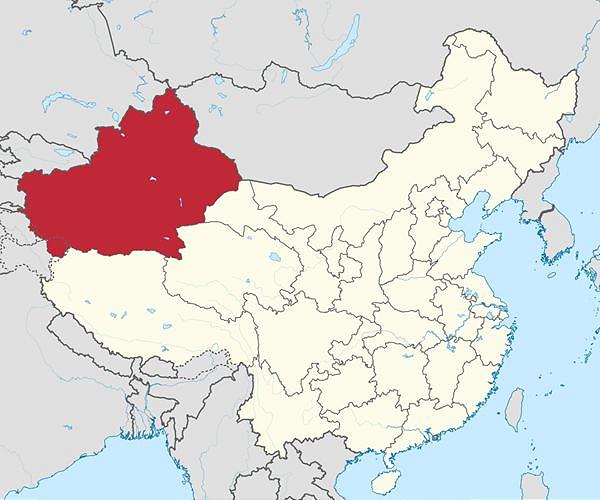
The vast region of Xinjiang makes up around one-sixth of China's continental territory.
Its population of around 26 million includes Uyghurs, Kazakhs, Kyrgyz and other minority groups.
A resource-rich region of desert, grassland and mountain ranges, Xinjiang borders eight nations including Russia, Afghanistan and Pakistan.
Lying on the ancient Silk Road, it holds valuable natural resources like coal, oil and gas, as well as precious metals and stones.
The region has swung in and out of Chinese rule over the centuries, but fell back into Beijing's orbit as the Communist Party launched a military-led settlement programme after taking control of the country in 1949.
– Who are the Uyghurs? –
The Uyghurs are a mostly Muslim ethnic group who speak a Turkic language and are culturally closer to communities in Central Asia than Beijing.
Around 12 million of them live in Xinjiang — making up around 45 percent of the population — with their cultural heartlands lying primarily in the region's arid south.
In 1953, the Uyghur population was more than 75 percent of the region, according to a census cited in the UN report. The ethnic Han Chinese accounted for seven percent. That number now stands at around 42 percent.
Historically, some Uyghurs have opposed Chinese rule and favoured the establishment of an independent state referred to as East Turkestan.
They say Beijing has curbed Uyghur religious and cultural expression and primarily enriched its Han majority through development projects in Xinjiang.
– Why has Beijing targeted the Uyghurs? –
Beijing has stepped up security measures in Xinjiang in recent years in what it calls an effort to combat separatism and Islamic extremism.
Violent clashes involving both Uyghurs and Han killed around 200 people in the regional capital Urumqi in 2009.
A spate of violent incidents occurred over the following years, including a 2013 attack in Beijing's Tiananmen Square and a suicide bombing at Urumqi train station in 2014.
Authorities responded with a campaign to "strike hard" against alleged separatists, building security checkpoints in Xinjiang's cities while also conducting house raids and barring certain expressions of Islamic faith.
The crackdown has expanded dramatically since 2017 as Beijing has vowed to eradicate extremist thought once and for all.
– What is China accused of? –
Beijing stands accused of incarcerating over one million Uyghurs and other Muslim minorities in a network of detention facilities across Xinjiang.
Campaigners and Uyghurs overseas have said an array of abuses take place inside the facilities, including torture, forced labour, forced sterilisation and political indoctrination.
A UN report last year detailed "credible" evidence of torture, forced medical treatment and sexual or gender-based violence — as well as forced labour — in the region.
But it stopped short of labelling Beijing's actions a "genocide", as the United States and some other Western lawmakers have done.
China has long denied the allegations, calling them the "lie of the century" and insisting its actions in Xinjiang have helped to combat extremism and enhance development.
It has also said that all detainees have "graduated" from the centres.
