
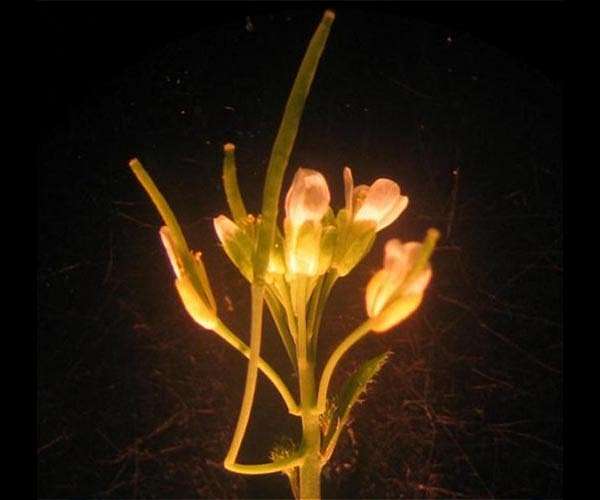
Thale cress, an unassuming flowering plant often found growing along roadsides and railway lines, has been known to scientists for centuries.
Over the last several decades, it has become a favorite plant model for botanists as hundreds of scientists have likely examined thousands of thale cress specimens under a microscope.
Despite all that attention, researchers reported the discovery of a previously unknown body part: a support structure dubbed the "cantil."
The cantil, described in a study published in the journal Development on Tuesday, attached at one end to the plant's stem and hangs to support the part of the stalk that yields flowers.
"I first observed the cantils in 2008," lead author Timothy Gookin said in a press release.
"I initially didn't trust any of the results. I thought it must be an artifact of genetic contamination, perhaps combined with environmental contamination of the water, soil, fertilizer or even the building air supply," said Gookin, a postdoctoral researcher at Pennsylvania State University.
According to the new study, cantils eluded botanists and the scientific literature for so long because they only emerge for a brief period of time under very specific conditions.
According to genetic analysis performed by Gookin and research partner Sarah Assmann, professor of plant biology at Penn State, some thale cress varieties have inherited mutations that prevent the development of cantils.
Though Gookin first spotted the unusual structures in 2008, he had to find a way to prove they were a natural structure, not a rare mutation or the product of genetic contamination.
After ten years of experimentation, Gookin and his research partners finally achieved a breakthrough.
"This study required the growth of 3,782 plants to full maturity and the manual inspection of over 20,000 flower-bearing stalks in 34 unique plant lines," Gookin said.
"I finally deemed the cantils a natural phenomenon after identifying them in wild-type (non-mutant) plants from different sources, which were growing in independent locations and diverse conditions," Gookin said.
During his decade of experimentation, Gookin found several thale cress varieties with more abundant cantil growth. These mutants helped scientists identify several genes that regulate cantil growth.
The researchers suggest the discovery is a reminder of the complicated relationships among growing conditions, evolution and gene regulation in plants.
"One speculative interpretation is that the cantil represents a highly repressed ancestral linkage between different types of flowering plant architectures; the multiple layers of genetic and environmental factors that regulate cantil development are certainly quite striking," Gookin said.
