
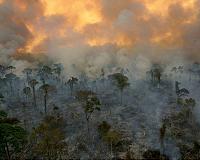
A tractor cuts a firebreak through the vegetation of the Pantanal, the world's biggest tropical wetlands, as firefighters race to contain the blazes that have been devastating one of the most biodiverse regions on Earth.
The Brazilian Pantanal suffered a record 1,684 fires last month, triple the number from July 2019, according to satellite images.
It was the worst month on record for fires in the region, which sits on the southern edge of the Amazon rainforest and stretches from Brazil into Paraguay and Bolivia.
Firefighters have been working around the clock to contain the blazes, with the help of residents of the city of Pocone and the surrounding area.
"We've been fighting this one for about 10 days. We've already lost 50,000 hectares," or 125,000 acres, firefighter Adrison Parques de Aguilar told AFP.
Eighty percent of the Pantanal is typically covered in water in the rainy season. But the region has had a drought this year, leaving large swathes of vegetation at risk of going up in flames.
The fires are sometimes set by ranchers clearing land to graze cattle, even though President Jair Bolsonaro, under pressure to protect the Amazon and the Pantanal, decreed a four-month ban on agricultural fires in July.
Dozens of columns of smoke rise along the Transpantaneira, a highway linking the region's ranches and tourist destinations.
"The flora and fauna are being devastated. This is causing irreparable environmental damage," said Aguilar.
The firefighters advance single file through the wetlands, putting out remnant fires and looking for others burning underground.
The last in line carries a rifle to fend off jaguars.
The region is also home to yellow anacondas, jabiru storks, giant otters, toucans, macaws and hundreds of other species.
Human inhabitants, meanwhile, are worried about the impact the smoke will have on their health.
The issue is all the more pressing amid the coronavirus pandemic, which has caused more infections and deaths in Brazil than any other country except the United States.
The smoke only increases the risk of respiratory emergencies in a region already facing an onslaught of them because of the virus.
"It's the dry weather that's causing all this. We haven't had rain in months," said rancher Antonio Santana Correia Marques.
"The Pantanal needs rain."
Malaysia ditches law to combat forest fire smog
Kuala Lumpur (AFP) Aug 4, 2020 –
Malaysia was criticised Tuesday for abandoning plans to introduce legislation that would have punished its firms operating in neighbouring Indonesia if they are found to have caused smog-belching forest fires.
Massive blazes, often started to clear land for palm oil plantations, burn out of control in Indonesia every year, blanketing the region in toxic smoke.
Last year's were the worst since 2015 due to dry weather, with the haze forcing many schools in Indonesia and Malaysia to close and putting the health of millions at risk.
Indonesia claimed that fires had blazed out of control on some plantations owned by several Malaysian firms.
This prompted the Malaysian government to look at drafting a law that would have punished companies from the country found to have contributed to causing smog-producing fires overseas.
But a new administration that took office in March announced Monday it was ditching the plan.
Environment Minister Tuan Ibrahim Tuan Man said officials would instead work with other countries in the region to tackle the problem and pointed to a similar law in Singapore, which has been criticised as ineffective.
But Greenpeace Malaysia campaigner Heng Kiah Chun criticised the "premature shelving" of the law.
"Taking action against Malaysian-owned companies operating abroad that contribute to the haze is a good step to ensure that the companies operate responsibly," he told AFP.
"The haze has been affecting Southeast Asian countries for years — tackling this regional haze is in the interest of everyone."
Indonesia has already been hit by fire outbreaks this year, although there has not been a major spread of smog across the region yet.
Last month, an Indonesian province on Borneo island declared a state of emergency while in May tens of thousands of personnel and water-bombing aircraft were deployed to tackle the season's first blazes.
There are growing fears over Indonesia's ability to tackle the crisis this year, with funds and personnel redirected to battling an escalating coronavirus outbreak.
