
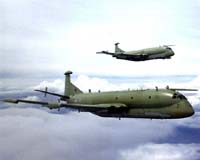
Britain is to temporarily withdraw Nimrod spy planes from overseas operations to carry out safety modifications ordered after a deadly crash in Afghanistan, a government minister said Monday.
Fourteen servicemen were killed in the 2006 crash, when their Nimrod exploded in mid-air shortly after refueling, in the British military's single biggest loss of life in a single incident for nearly 25 years.
An inquiry into the crash in Kandahar province called for the replacement of fuel seals and engine bay hot-air ducts — modifications which should have been completed by March, but which have been delayed.
Armed Forces Minister Bob Ainsworth said the temporary suspension of overseas operations "will allow us to free up the maximum number of aircraft for the modification programme, while also allowing Nimrod to continue with its critical homeland security tasks".
"During this period, we will use other UK and coalition assets to maintain an effective surveillance capability overseas," he added.
The coroner at the inquest into the 14 deaths concluded last year that Britain's entire fleet of Nimrod spy planes has never been airworthy — a finding disputed by the Ministry of Defence.
Ainsworth said Monday: "We have reassessed the situation in the light of these developments and concluded that the Nimrod fleet remains airworthy and safe to fly, subject to the measures outlined above."
The Royal Air Force operates 16 Nimrod MR2 reconnaissance aircraft — with its distinctive "double bubble" fuselage — out of its base at Kinloss in northeast Scotland.
Graham Knight, whose 25-year-old son Ben was among the victims of the 2006 crash, described Monday's announcement as a "vindication" of what coroner Andrew Walker said.
"This is what we were asking for back after the inquest. We all said that we would like these repairs and modifications to be carried out before they flew again," he said.
