
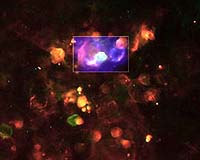
Using the Chandra X-ray Observatory, astronomers explored a particular region of clouds and gas where stars are forming in one of the Milky Way's closest galactic neighbors. Combining X-ray data (blue and purple) with other wavelengths, researchers found evidence for the formation of a so-called superbubble. Superbubbles are formed when smaller structures from individual stars and supernovas combine into one giant cavity. The Chandra data shows evidence for three supernova explosions in this relatively small region.
The Chandra X-ray Observatory is part of NASA's ?eet of "Great Observatories" along with the Hubble Space Telescope, the Spitizer Space Telescope and the now deorbited Compton Gamma Ray Observatory. Chandra allows scientists from around the world to obtain unprecedented X-ray images of exotic environments to help understand the structure and evolution of the universe. Already surpassing its ?ve-year life, NASA's Chandra X-ray Observatory is rewriting textbooks and helping advance technology.
Chandra X-ray Center
The Smithsonian Astrophysical Observatory (SAO) in Cambridge, Mass., is responsible for the conduct of the day-to-day ?ight operations and science activities from the Operations Control Center and Chandra X-ray Center (CXC) facilities. SAO also coordinates science planning for the observing program and provides user support as science products are made available to the scienti?c community. The CXC Web site is the primary resource for information on the Chanda X-ray Observatory mission, providing comprehensive materials such as news releases, photos, status reports, and mission background materials.
