
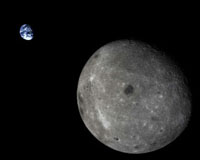
China completed its first return mission to the moon early Saturday with the successful re-entry and landing of an unmanned probe, state media reported, in the latest step forward for Beijing's ambitious space programme.
The probe landed safely in northern China's Inner Mongolia region, state news agency Xinhua said, citing the Beijing Aerospace Control Center.
Xinhua said the probe took "some incredible pictures" of the Earth and the moon.
Prior to re-entering the Earth's atmosphere, the unnamed probe was travelling at 11.2 kilometres per second (25,000 miles per hour), a speed that can generate temperatures of more than 1,500 degrees Celsius (2,700 degrees Fahrenheit), the news agency reported.
To slow it down, scientists let the craft "bounce" off Earth's atmosphere before re-entering again and landing.
The probe's mission was to travel to the moon, fly around it and head back to Earth, the State Administration of Science, Technology and Industry for National Defence (SASTIND) said in a statement at its launch eight days ago.
The module would have been 413,000 kilometres from Earth at its furthest point on the mission, SASTIND said at the time.
The mission was launched to test technology to be used in the Chang'e-5, China's fourth lunar probe, which aims to gather samples from the moon's surface and will be launched around 2017, SASTIND previously said.
Beijing sees its multi-billion-dollar space programme as a marker of its rising global stature and mounting technical expertise.
The military-run space project, which has plans for a permanent orbiting station by 2020 and eventually to send a human to the moon, is also seen as evidence of the ruling Communist Party's success in turning around the fortunes of the once poverty-stricken nation.
China currently has a rover on the surface of the moon.
The craft, called the Jade Rabbit and launched as part of the Chang'e-3 lunar mission late last year, has been declared a success by Chinese authorities, although it has been beset by mechanical troubles.
Chinese unmanned lunar orbiter returns home, first in nearly four decades
BEIJING, Nov. 1 (Xinhua) — China succeeded Saturday in the world's first mission to the Moon and back for some 40 years, becoming the third nation to do so after the former Soviet Union and the United States.
The test lunar orbiter, nicknamed "Xiaofei" on Chinese social networks, landed in Siziwang Banner of China's Inner Mongolia Autonomous Region early Saturday morning.
The last documented mission of this kind was by the Soviet Union in the 1970s.
"Xiaofei" is mean to test technologies that will be used in the Chang'e-5 mission, scheduled for 2017 when an unmanned spacecraft will land on the moon, collect a soil sample and return to Earth.
The landing site is about 500 kilometers away from Beijing.
Launched Friday last week, the orbiter traversed 840,000 kilometers on its eight-day mission that saw it round the far side of the Moon and take some incredible pictures of Earth and Moon together.
The re-entry process began at around 6 a.m. Saturday morning, with the orbiter approaching Earth at a velocity of about 11.2 kilometers per second.
The high speed led to hefty friction between the orbiter and air and high temperatures on the craft's exterior, generating an ion sheath that cut off contact between ground command and the orbiter.
To help it slow down, the craft is designed to "bounce" off the edge of the atmosphere, before re-entering again. The process has been compared to a stone skipping across water, and can shorten the "braking distance" for the orbiter, according to Zhou Jianliang, chief engineer with the Beijing Aerospace Command and Control Center.
"Really, this is like braking a car," said Zhou, "The faster you drive, the longer the distance you need to bring the car to a complete stop."
The "bounce" was one of the biggest challenges of the mission, because the craft must enter the atmosphere at a very precise angle. An error of 0.2 degrees would have rendered the mission a failure.
Wu Yanhua, vice director of China's State Administration of Science, Technology and Industry for National Defense, said the test mission has gathered a lot of experimental data and laid a solid foundation for future missions.
