
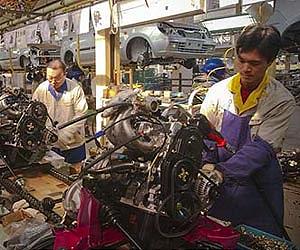
Manufacturing activity in China picked up pace in September, a government survey showed Friday, providing a counterweight to concerns that the world's second-biggest economy is slowing down.
The purchasing managers index rose to 53.8 in September from 51.7 in August, the China Federation of Logistics and Purchasing (CFLP) said in a statement.
The results come after an independent survey of purchasing managers showed manufacturing hit a five-month high last month.
The HSBC China Manufacturing PMI rose to 52.9 in September from 51.9 in August as production and new orders rose.
A reading above 50 means the sector is expanding, while anything below 50 indicates a decline.
China's economy grew 10.3 percent year-on-year in the second quarter compared with 11.9 percent in the first three months as government efforts to rein in soaring property prices and bank lending started to bite.
Analysts have warned China's manufacturing sector will face weaker demand in major export markets in the second half as the United States struggles to recover from the global recession and Europe deals with its debt crisis.
This has sparked concerns that China's export-driven economy could hit the brakes in the last six months of the year.
Bank of America Merrill Lynch economist Lu Ting however said the rebound in manufacturing activity since July shows "the limited impact of the property tightening measures on developers' construction activities".
"We gain more confidence to maintain our 10.1 percent annual gross domestic product growth in 2010 and nine percent in the fourth quarter," Lu said in a note.
Hong Kong-based HSBC chief economist Qu Hongbin also downplayed the risks of a sharp slowdown in the economy.
"A pick-up in new orders means that domestic demand is still strong," Qu said this week.
"Despite uncertainties on growth in global demand, we expect China to rely on continued investment in ongoing infrastructure projects and resilient consumption to grow by around nine percent in the rest of the year and 2011."
HSBC's results are based on interviews with purchasing managers at more than 400 companies, while the CFLP survey covers more than 700 firms.
Share This Article With Planet Earth
