
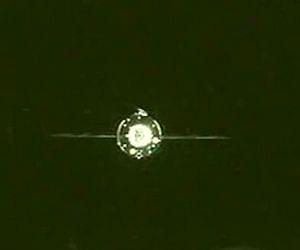
China's space control network has realized integrated command and control, which ensured the successful docking of the unmanned spacecraft Shenzhou 8 with the space lab module Tiangong 1, according to the Beijing Institute of Tracking and Communication Technology. This institute is the general design organization for the integration test of China's aerospace measurement and control network.
On the eve of the docking, the first for China, scientists from this institute upgraded the systems of the Relay Satellite Control Center, the Space Object Collision Warning Analysis Center and other space centers in Beijing as well as Jiuquan of Gansu province and Xi'an of Shanxi province.
All five centers are integrated to build a center group with a high degree of shared information and collaborative business.
2nd docking of Tiangong-1 and Shenzhou-8 on schedule
Tiangong-1 and Shenzhou-8 have now orbited together for more than 90 hours. In just over a week's time, the two will carry out a second docking if all tests run smoothly.
The second docking will be conducted with poorer orbit and light conditions purposely to test the reusability of the docking systems.
Wang Xiang, deputy chief engineer of Manned Spacecraft System, said, "To make the second docking possible, the two modules need to be first disconnected. And then they will have to be reconnected perfectly. The whole process is new to us."
The Shenzhou -8 is equipped with microwave radar, laser radar and a high-resolution imaging sensors to accomplish the docking. It is also important to test whether radars and sensors can be used under different conditions in the second docking.
Wang Xiang, deputy chief engineer of Manned Spacecraft System, said, "The sensors have different reactions under different conditions. All space engineers will meet this problem. The only way to overcome the problem is to test the sensors in a different orbit in the second docking. This test also adds some uncertainties to the success of the second docking."
The Shenzhou-8 and Tiangong-1 will orbit together for a total of 12 days doing tests. Then a second docking will be followed by two days' flight. Shenzhou-8 is scheduled to return to Earth on November 17th.
China's two data relay satellites take turns to guarantee space docking
During China's first space rendezvous and docking, the data relay satellite system, which is made up of Tianlian I-01 and Tianlian I-02 data relay satellites, took turns tracking the two targets of space module Tiangong 1 and spacecraft Shenzhou 8 and provided them with space monitoring and control as well as data relay services.
Huang Huiming, deputy director of the monitoring, control and communications system of China's manned space program, said that the entire rendezvous and docking process of Tiangong 1 and Shenzhou 8 spacecraft was all within the monitoring, control and communications scope of the relay satellite system.
Tianlian I-01 and Tianlian I-02 have considerably decreased the monitoring, control and communication time of the rendezvous and docking and enhanced the reliability of the mission by taking turns to acquire and track Tiangong 1 and Shenzhou8 spacecraft that are within the same scope of wave beam.
The relay satellite system will also continue to play major monitoring, control and communications roles during the follow-up operations of the combined spacecraft, second experiment of the rendezvous and docking as well as the return of Shenzhou 8.
