
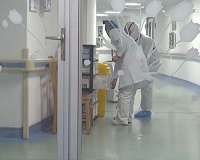
Nine Chinese experts and several tonnes of medical aid have arrived on a special to flight to Italy to help the country fight Europe's most serious coronavirus outbreak.
China, the epicentre of the outbreak that first emerged in December, has said the peak of the epidemic has passed in the country after a steady decline in the number of new cases.
After battling the deadly epidemic for several months, it has also sent support to Iran and Iraq to help fight the illness.
On Thursday, a flight carrying medical experts and supplies arrived in Rome to help the hard-hit country, which has more than 15,000 cases and over 1,000 deaths — the most outside of China.
The specialists had "been on the frontline since the first day in the epicentre of the virus", said Francesco Rossa, the president of the Italian Red Cross.
"The exchange of experiences with our researchers is important."
The team included the vice president of the Chinese Red Cross and a prominent cardio-pulmonary intensive care expert, along with pediatricians and nurses who worked on the virus outbreak in China.
The medical supplies included ventilators, respiratory material, electro-cardiography machines and tens of thousands of masks, Rossa said.
Sporting face masks, the Chinese specialists were met by Italian health officials in Rome as they arrived for the visit.
In a phone call earlier this week, China's Foreign Minster Wang Yi told his Italian counterpart Luigi Di Maio that Italy would have Beijing's full support in battling the outbreak.
The outbreak has killed over 3,100 people in China and infected more than 80,000, the highest number globally.
Italy is the second-worst affected country, and has issued a nationwide lockdown in a bid to contain the pandemic.
Italians in China caught between two epidemics
Beijing (AFP) March 14, 2020 –
Sara Platto's mother in Italy called her "crazy" for staying in Wuhan even as the virus-hit city was quarantined in January. Now she's offering advice to people back home on how to cope.
Platto, who lives with her 12-year-old son at the epicentre of the coronavirus pandemic, rejected four offers of evacuation from the Italian government after refusing to abandon her two cats and deciding it was safe enough to stay in China.
"It's not Ebola," Platto, who works at Jiangnan University, told AFP.
She has spent more than 50 days cooped up at home, taking turns with her son to use one computer for online classes and work.
Italians enduring China's health crisis and draconian measures that have left them effectively housebound for weeks now find themselves watching similar scenes unfold at home.
Italy — where the virus has killed more than 1,000 people in just over two weeks, making it the hardest-hit country outside China where over 3,100 have died — has imposed a lockdown unprecedented in Western Europe.
All stores except for pharmacies and food shops have been closed and residents are to stay at home except to travel to work, shop for provisions, or seek medical help.
"They are freaking out, because it's something they're not used to," Platto said of people in her home city of Brescia in the northern region of Lombardy, where most of Italy's infections have been detected.
"What I'm saying to everybody is don't panic, because panic is worse than a virus."
– Surveillance –
Platto's Chinese neighbours in Wuhan were touched by her decision to stay in the city, where the virus was first detected in December and has been cut off from the world with no air transport since January 23.
They brought her a "big bag of spaghetti" and a note that said "Sara, be strong" after learning that she was from Italy.
But as the number of infections in China falls while overseas outbreaks continue to grow, Chinese authorities have stepped up surveillance of foreigners for fear of imported cases.
Beijing on Wednesday ordered all international arrivals to the city to go into 14-day quarantine, while airline passengers from Italy, Iran, South Korea and Japan are being handled separately from other travellers.
In one central Beijing district, neighbourhood volunteers and police repeatedly demanded information from Italians specifically, including making unannounced house calls, even for people who had not left China recently.
Francesco Abbonizio, a youth football coach in the capital, spent the first two weeks of his time on a recent trip to Italy avoiding social contact — and now has to quarantine himself again after returning to China on Wednesday.
"Someone in my family was very scared of the virus and refused to meet me even after the two weeks," he said.
"Right now all of them are locked down in their house."
– Trip cancelled –
Marco, a Beijing resident working in the theatre industry, has not left China since the start of the outbreak and cancelled a planned trip home to Italy in March, his first in over two years.
He said he did not want to "create panic" arriving from China in his Tuscan hometown of only 16,000 people with his wife, who is Chinese.
"People are not always so good at rationalising things," he told AFP, adding that he did not want his family to endure any negative reaction from other residents of his hometown.
Before Italy confirmed its first cases of the virus, Chinese communities in the country said they faced racist behaviour.
Chinese tourists were spat at in Venice, a family in Turin was accused of carrying the disease, and mothers in Milan used social media to call for Italian children to be kept away from Chinese classmates.
"I am worried more for my family actually," Marco said, "and about the poor sense of community that my country is having lately."
