
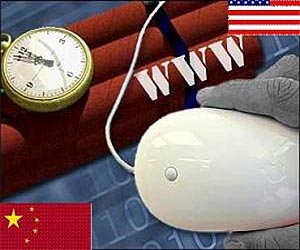
China's parliamentary leader Wu Bangguo has called on the United States to respect its "core interests" in talks with US senators, following Google's threat to leave the country, state media reported.
The reported comments from Wu — officially the second-ranking figure in the government hierarchy behind President Hu Jintao and ahead of Premier Wen Jiabao — did not specifically mention the Google case.
Xinhua news agency quoted Wu as telling a delegation of visiting US senators that the two sides should "respect each other's core interests and properly handle sensitive affairs" in order to maintain good ties.
The phrase is typically used by Chinese leaders to express their displeasure about diplomatic or other developments.
Wu also said in the half-hour meeting on Wednesday that Washington and Beijing should handle ties from a "strategic and long-term point of view," the report said.
Google announced on Tuesday it would no longer censor search engine results in China and possibly pull out of the world's largest online market, complaining about cyberattacks and censorship by the communist regime.
China-based cyber spies struck the Internet giant and reportedly more than 30 other firms in an apparent bid for computer source codes, intellectual property, and information about human rights activists around the world.
US Secretary of State Hillary Clinton has asked Beijing for an explanation on the Google case, and the White House confirmed it had held talks with the Internet firm on the matter.
Wu called the China-US relationship "one of the world's most important" and said ties had leapt forward in 2009 since US President Barack Obama came to power.
Microsoft, HP fail to back Google's China move: FT
Washington (AFP) Jan 14, 2010 –
The chief executives of Microsoft and Hewlett-Packard have declined to back Google's threat to pull out of China over censorship and cyberattacks, the Financial Times reported on Thursday.
Microsoft chief executive Steve Ballmer described Google's row with China as "the Google problem," the FT said, while Mark Hurd, CEO of computer maker HP, called China "an amazing market with tremendous growth."
"Every large institution is being hacked," the newspaper quoted Ballmer as saying. "I don't think it's a fundamental change in the security environment on the Internet."
The FT said Ballmer declined to indicate whether Microsoft would stop censoring results on its Bing search engine in China.
Google announced on Tuesday that it would no longer filter search results in China and said it may be forced to pull out of the world's largest online market of 360 million users.
Google said the move was a protest against censorship and what it called "highly sophisticated" cyberattacks which were aimed at Chinese human rights activists and believed to have originated in China.
The FT quoted Ballmer as saying China represents a big business opportunity for Microsoft as it tries to persuade more people who use pirated copies of its software to pay for it.
The newspaper said both Ballmer and Hurd played down any wider threat to Internet security from the attacks which Google said were aimed at more than 20 other companies. Some reports have put the number of targeted firms at over 30.
"I'd hate to run off on this one example and say it's a threat to the evolution of the IT industry," Hurd told the FT.
Microsoft and HP on Wednesday announced they were forging a strategic partnership and investing 250 million dollars over the next three years to develop Internet-based cloud computing systems.
China employs a vast system of Web censorship that blocks content such as political dissent, pornography and other information viewed as objectionable.
Google, Cisco, Microsoft and Yahoo! have come under attack in recent years from rights groups, members of the US Congress and others, accused of abetting what has been dubbed the "Great Firewall of China."
Top US lawmakers have praised Google for its move this week and the Internet giant has also earned the backing of rival Yahoo!.
"We stand aligned with Google that these kinds of attacks are deeply disturbing and strongly believe that the violation of user privacy is something that we as Internet pioneers must all oppose," a Yahoo! spokeswoman said.
White House spokesman Robert Gibbs confirmed on Wednesday that President Barack Obama's administration had held talks with Google.
While declining to offer details, he stressed the United States backed the "right to a free Internet."
China will lose out if Google quits: state paper
Beijing (AFP) Jan 14, 2010 –
China will lose out if Google makes good on a threat to quit the country over cyberattacks and censorship, a state newspaper warned Thursday, saying people had the right to a free flow of information.
"Should the world's most populous nation fail to provide a foothold to the world's top search engine, it would imply a setback to China and serious loss to China's Net culture," said the English-language Global Times, run by the Communist Party mouthpiece the People's Daily.
It said if the US Internet giant pulled out of the country with the world's largest online population at 360 million, it would be "an incalculable loss to its long-term commitment to innovation" as well as a loss of future business.
Google vowed Tuesday to stop bowing to Chinese Internet censors and risk banishment from the lucrative market to protest "highly sophisticated" cyberattacks aimed at Chinese human rights activists.
"The information highway demands not only safe driving but also free flow of traffic. And, in the interests of the majority's right to know, free flow of information should take precedence in a civil society," the Global Times said.
"Google and China going their separate ways would hurt both sides."
Some popular Chinese-language state-run newspapers also ran reports that mentioned Google's allegations which are widely seen as a slap in the face to the government.
The Beijing News also reported that people were visiting Google's offices in Beijing, placing flowers and other gifts in a show of support.
Such sensitive subjects are typically not widely reported by the nation's tightly-controlled media.
China has said it was seeking more information about the announcement. Requests for comment from the foreign, commerce and information technology ministries were not immediately answered.
The Global Times — which splashed the story on its front page, as did the state-run China Daily — said while censorship was justified in a "transitional society" like China to maintain social stability, some limits were needed.
"The government must face up to the challenge of where and how to put the checkpoints on the (information) highway," it said.
Share This Article With Planet Earth
