
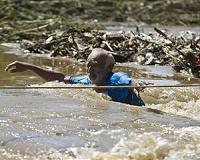
Soaring carbon emissions will amplify the risk of conflict, hunger, floods and mass migration this century, the UN's expert panel said Monday in a landmark report on the impact of climate change.
Left unchecked, greenhouse gas emissions may cost trillions of dollars in damage to property and ecosystems, and in bills for shoring up climate defences, it said, adding the impact would increase with every additional degree that temperatures rise.
"Increasing magnitudes of warming increase the likelihood of severe, pervasive, and irreversible impacts," a summary said, in a stark message to policymakers.
The report is the second chapter of the fifth assessment by the Intergovernmental Panel on Climate Change (IPCC), set up in 1988 to provide neutral, science-based guidance to governments.
The last overview, published in 2007, unleashed a wave of political action that at one point appeared set to forge a worldwide treaty on climate change in Copenhagen in 2009.
But a global consensus failed to emerge as the developing world and developed world squabbled, with big polluters like China insisting it was up to rich countries to take the lead, arguing they could not be expected to sacrifice growth.
And in the United States, President Barack Obama's attempts at passing climate change legislation have been stymied in Congress, where some Republicans remain unconvinced of the scientific case for warming and argue that mitigation efforts are an unnecessary block on economic growth.
The new document, unveiled in Yokohama after a five-day meeting, gives the starkest warning yet by the IPCC of extreme consequences from climate change, and delves into greater detail than ever before into the impact at regional level.
It builds on previous IPCC forecasts that global temperatures will rise 0.3-4.8 degrees Celsius (0.5-8.6 degrees Fahrenheit) this century, on top of roughly 0.7 Celsius since the Industrial Revolution.
Seas are forecast to rise by 26-82 centimetres (10-32 inches) by 2100.
Warming of around two degrees Celsius over pre-industrial times may cost 0.2-2.0 percent of global annual income, said the new report. UN members have pledged to hammer out a global pact by the end of 2015 to limit warming to 2 C above pre-industrial levels.
– Security risk –
The impact amplifies with every degree, and beyond 4 C could be disastrous, said the report.
Climate change could drive turbulence and conflict, prompted by migration from newly uninhabitable areas and jockeying for water and food, it said.
"There are many things that make people vulnerable, and when you combine a climate shock with these factors, you can have bad outcomes," said Chris Field, co-chair of the conference.
"With high levels of warming that result from continued growth in greenhouse gas emissions, risks will be challenging to manage, and even serious, sustained investments in adaptation will face limits."
Rainfall patterns will be disrupted, resulting in a significantly higher flood risk, especially for Europe and Asia — and magnified drought risks will add to water stress in arid, heavily populated areas, the report said.
This, in turn, will have consequences for agriculture. Yields of staples such as wheat, rice and corn will be squeezed, just as demand will soar because of population growth, it predicts.
The report says climate change will also have a ricochet effect on health, through the spread of mosquito- or water-borne diseases and heatwaves.
Vulnerable plant and animal species, especially in fragile coral reefs and Arctic habitats, could be wiped out.
– Denial is 'malpractice' –
US Secretary of State John Kerry said the document sounded an alarm that could not be ignored.
"Unless we act dramatically and quickly, science tells us our climate and our way of life are literally in jeopardy," he said. "Denial of the science is malpractice.
"There are those who say we can't afford to act. But waiting is truly unaffordable. The costs of inaction are catastrophic," he added.
The report said the danger could be substantially reduced, especially for those alive at the end of the century, if greenhouse gas emissions are cut swiftly.
Even so, countries will have to shore up their defences — for instance, by making water supplies, coastal areas, homes and transport more climate-resilient.
Many of the measures for adapting to climate change — reducing water wastage, planting parks to ease heat build-up in cities, and preventing people from settling in risky areas — are cheap and achievable, it said.
The report was hailed by campaign groups as a call to arms for political leaders around the world.
"It's not just polar bears, coral reefs and the rain forest under threat. It is us," said Kaisa Kosonen, senior political adviser for Greenpeace International.
"Climate change's impact can now be detected everywhere. It's already hurting us. How bad it will get depends on the choices we will make.
"Governments own this report. Now we expect them to take it home and act on it."
Tom Mitchell of the Overseas Development Institute, a British think tank, said a lowering of ambitions since the failure of Copenhagen might allow progress towards a global plan of action to combat the problem.
"I'm more hopeful that we'll get some kind of agreement, but it's not going to be quite the one that the world needs," he said.
Climate change: regional impact
Yokohama, Japan (AFP) March 31, 2014 –
This is how climate change may affect the world's regions this century, as forecast in a major report published by UN scientists Monday.
The report is part of the fifth overview on global warming by the Intergovernmental Panel on Climate Change (IPCC) since 1988.
The document identifies each region's key challenges; options for addressing them; and level of risk from warming of either 2 C (3.6 F) or 4 C (7.2 F) by 2100 compared to pre-industrial levels. This risk is calculated on the basis of present policies for adapting to climate change.
AFRICA
Challenge: Water stress
Risk: High at 2 C, very high at 4 C
Options: Smarter use of water resources
Challenge: Food shortages
Risk: Very high at 2 C and 4 C
Options: Stress-tolerant crops, help for small farmers
Challenge: Mosquito- and water-borne diseases
Risk: Very high at 2 C and 4 C
Option: Outbreak early-warning systems, improved sanitation
EUROPE
Challenge: Flooding in river basis and on coasts
Risk: Medium at 2 C, very high at 4 C
Options: Improve flood protection
Challenge: Water stress in dry regions
Risk: High at 2 C, very high at 4 C
Options: Reduce water waste, including through irrigation
Challenge: Heatwaves and air pollution affecting health
Risk: High at 2 C, very high at 4 C
Options: Reduce emissions to improve air quality and adapt homes and workplaces for heatwaves.
ASIA
Challenge: Flood damage to homes and infrastructure
Risk: High at 2 C, very high at 4 C
Options: More resilient buildings and "selective relocation"
Challenge: Deaths from extreme heat
Risk: Very high at 2 C and 4 C
Options: Strengthen health systems, improve city planning to reduce urban heat buildup
Challenge: Malnutrition caused by drought
Risk: Medium at 2 C, high at 4 C
Options: Beef up vigilance on food supplies, improve disaster preparedness
AUSTRALASIA
Challenge: Damage to coral reefs and, in Australia, animal and plant species loss
Risk: High at 2 C, very high at 4 C
Options: Reduce pressures on ecosystems from pollution, tourism and introduced species
Challenge: Flooding, and coastal infrastructure lost to rising seas
Risk: Medium at 2 C, very high at 4 C
Options: Smarter land use to reduce exposure to floods and coastal erosion.
NORTH AMERICA
Challenge: Wildfires for ecosystems and homes
Risk: Very high at 2 C and 4 C
Options: Improve fire prevention measures
Challenge: Deaths from heatwaves
Risk: High at 2 C, very high at 4 C
Options: Encourage residential air conditioning, build cooling centres for the vulnerable
Challenge: Property and infrastructure damage from extreme rainstorms
Risk: High at 2 C, very high at 4 C
Options: Install drainage systems that allow water runoff to recharge groundwater resources, easing flood risk
CENTRAL AND SOUTH AMERICA
Challenge: Water stress in semi-arid areas that depend on glaciers for water supply
Risk: Very high at 2 C and 4 C
Options: Improve water supply and land use
Challenge: Flooding in urban areas from extreme rainfall
Risk: Very high at 2 C and 4 C
Options: Improve urban flood management, early-warning systems and weather alerts
Challenge: Decreased food production and food quality
Risk: Very high at 2 C and 4 C
Options: Develop drought-resistant crop strains
POLAR REGIONS
Challenge: Risk to ecosystems from changes to permafrost, snow and ice
Risk: High at 2 C , very high at 4C
Options: Enhanced monitoring of risk, hunt different species if possible
Challenge: Food insecurity and lack of reliable and safe drinking water
Risk: Very high at 2 C and 4 C
Options: Improve monitoring systems, shift resources, settle elsewhere
Challenge: Impact on Arctic communities if climate change happens very fast
Risk: Very high at 2 C and 4 C
Options: Improve communications, education and training, encourage co-management of ecosystem
SMALL ISLANDS
Challenge: Loss of homes, farmland, infrastructure and livelihoods from rising seas and storms
Risk: High at 2 C, very high at 4 C
Options: Boost coastal buffers and improve management of water and soil resources
Challenge: Loss of low-lying land in coastal areas from a combination of rising seas and storm surges
Risk: Very high at 2 C and 4 C
Options: Not constructing new buildings in areas at risk
OCEANS
Challenge: Decline in fish catches at low latitudes
Risk: Medium at 2 C, high at 4 C
Options: Flexible management reactive to stock variability, expanding aquaculture
Challenge: Biodiversity loss from heat-damaged coral reefs
Risk: Very high at 2 C and 4 C
Options: Reduce other human-induced stresses like pollution, tourism and fishing
Challenge: Damage to coastal ecosystems such as mangroves and sea grass from soil runoff from heavy rain and coastal erosion
Risk: High at 2 C, very high at 4 C
Options: Reduce soil runoff caused by deforestation
SOURCE: "Climate Change 2014: Impacts, Adaptation, and Vulnerability " (Summary for Policymakers)
