
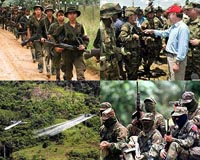
The Colombian government's chief peace negotiator with the country's last rebel group said Monday he will step down in January when a ceasefire with ELN guerrillas comes to an end.
Juan Camilo Restrepo, a 71-year-old former justice minister, has led the government delegation in several rounds of peace talks in the Ecuadorian capital Quito since February.
President Juan Manuel Santos said Restrepo's resignation would mean a shake-up in the government's negotiating team as both sides seek to extend the ceasefire beyond January 9.
"We are going to renew the team and continue the process, to see if we can resume the ceasefire and continue with the negotiation," Santos said.
Santos is pushing to sign a deal with the ELN to follow on from the success of a December 2016 peace deal with the South American country's other main rebel movement, the FARC.
Restrepo — who said he is stepping down for personal reasons — admitted his 18 months at the helm of the peace negotiations had not been easy but he believed progress has been made.
The ELN said on Twitter that it hoped the renewal of the government team would bring momentum to the peace process.
In a statement, the group said the ceasefire deal was at risk even though the parties had managed to sustain it and deliver humanitarian aid to the regions of greatest conflict.
It said the government violated the agreement when nine farmers involved in coca production were killed by security forces during a protest, and in two military attacks on ELN camps.
It also denounced what it said were attacks on imprisoned guerrillas.
The National Liberation Army, or ELN, began the historic truce with Colombia's armed forces on October 1, after half a century of fighting.
FARC and the ELN were formed in 1964 to fight for land rights and protect poor rural communities.
In what became a many-sided war fueled by drug trafficking, Latin America's longest conflict left some 260,000 dead, 60,000 unaccounted for and seven million displaced.
Red Cross identifies remains of 88 Argentine soldiers in Falklands
The Red Cross said Friday its forensic team had identified the remains of 88 Argentine soldiers buried in the Falkland Islands after being killed fighting against Britain over the territory.
The International Committee of the Red Cross had gathered samples from 121 remains of unidentified soldiers buried in Darwin military cemetery on the remote South Atlantic islands, known in Spanish as M … read more
