
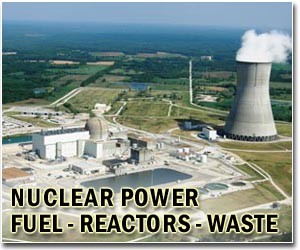
Germany's opposition filed a suit in the country's highest court on Monday trying to reverse an unpopular postponement of when Europe's top economy abandons nuclear power.
"The decision to extend nuclear reactors' operating periods will fail to stand up," predicted Frank-Walter Steinmeier, parliamentary head of the centre-left Social Democrats (SPD).
The lower house of parliament, the Bundestag, late last year approved Chancellor Angela Merkel's plans to postpone by on average 12 years the operating times of Germany's 17 nuclear power plants.
But the opposition argues that the extension should have also gone before the upper house, the Bundesrat, where Merkel's governing coalition lost its majority last May.
This was "without doubt unconstitutional," said former environment minister Juergen Trittin from the opposition Greens, which together with the SPD co-authored in 2000 an exit from nuclear power by 2020.
With no permanent storage site for radioactive waste in place and fears about a repetition of a disaster in Germany like the 1986 Chernobyl meltdown in Ukraine, polls in 2010 indicated a majority of voters opposed an extension.
Tens of thousands of people demonstrated against it in Berlin in September, and in November a shipment of radioactive waste to a temporary storage site drew angry protests.
Merkel says she wants to divert some of the billions of euros (dollars) in extra profits that the extension will generate for power companies into expanding cleaner energy sources like solar or wind energy.
Nuclear power currently generates nearly one quarter of Germany's power, while renewables produce around 15 percent. The remainder comes from fossil fuels like coal.
Merkel's spokesman expressed confidence on Monday that the constitutional court would rule in its favour, saying the government was "still convinced" the extension did not need upper house approval.
A ruling could take months or even years.
Share This Article With Planet Earth
