
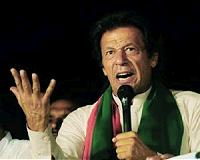
Pakistan's new Prime Minister Imran Khan was sworn in at a ceremony in Islamabad on Saturday, ushering in a new political era as the World Cup cricket hero officially took the reins of power in the nuclear-armed country.
The ceremony at the President's House in the capital marks the end of decades of rotating leadership between the ousted Pakistan Muslim League-Nawaz (PML-N) and the Pakistan Peoples Party (PPP), punctuated by periods of army rule.
A tearful Khan smiled as he stumbled over some of the words of the oath administered to him by President Mamnoon Hussain during the ceremony, televised live by the state broadcaster PTV.
He swore to "discharge my duties and perform my functions honestly, to the best of my ability… and always in the interest of the sovereignty, integrity, solidarity, well-being and prosperity of Pakistan".
The 65-year-old former cricketer, who captained Pakistan to World Cup victory in 1992, had won a confidence vote in the National Assembly the previous day.
In parliament on Friday he came out fighting with a divisive speech in which he vowed to hold corrupt officials accountable.
The July 25 election that brought his Pakistan Tehreek-e-Insaf party to power was branded "Pakistan's dirtiest", with accusations throughout the campaign that the military was trying to tilt the playing field in Khan's favour.
The army and Khan have denied claims from rival parties of "blatant" vote rigging.
– 'No dictator has taken care of me' –
Khan's third wife Bushra Bibi kept her eyes cast modestly downwards during Saturday's ceremony.
It was her first public appearance since their wedding earlier this year, and she appeared escorted by tight security and covered from head to toe in a white niqab, a conservative garment by Pakistani standards.
Khan had invited the rest of the 1992 cricket team to the ceremony, and fast bowler Wasim Akram was pictured smiling among the crowd.
Another cricketer-turned-politician, India's Navjot Singh Sidhu, was seated in the front row and earlier warmly embraced the powerful Pakistan army chief General Qamar Javed Bajwa.
Later, Khan went to the Prime Minister's house in the capital, where he was met by a guard of honour.
Khan campaigned on promises to end widespread graft while building an "Islamic welfare state".
"I promise to my God that everyone who looted this country will be made accountable," he said in Friday's speech to parliament.
He also defended himself against widespread claims the military had targeted the formerly ruling PML-N, especially its leader Nawaz Sharif, and fixed the playing field in Khan's favour.
"No dictator has taken care of me. I am standing here in this parliament on my own feet," he told the raucous assembly as opposition members shouted protest slogans.
Pakistan's 71-year history has been punctuated by coups and assassinations and the 2018 election was only its second ever democratic transition of power from one civilian government to another.
No prime minister of Pakistan has ever completed a full five-year term. Khan will have to contend with the same issue as many predecessors: how to maintain a power balance in civil-military relations.
The new 15-member cabinet was announced by PTI in a tweet.
Shah Mahmood Qureshi, who previously served as foreign minister under a PPP government until 2011 when he switched to PTI, returns to the role.
Pervez Khattak, the former chief minister of Khan's stronghold in Khyber Pakhtoonkhwa, was appointed defence minister.
– Myriad challenges –
Khan and his cabinet face a myriad of challenges including militant extremism, water shortages, and a rapidly growing population negating growth in the developing country, among others.
A massive power outage that plunged over 60 percent of the port city of Karachi and southwestern Balochistan province Friday evening starkly highlighted a chronic energy crisis the country faces.
Most pressing is a looming economic crisis, with speculation that Pakistan will have to seek a bailout from the International Monetary Fund.
PTI fell short of an outright majority in the July 25 vote, forcing Khan to partner with smaller parties and independents in order to form a government.
But it retained its stronghold in northwestern Khyber Pakhtunkhwa province and has made an alliance with regional parties in Balochistan.
The party is also expected to form a coalition government in powerful Punjab, formerly a PML-N stronghold. Southern Sindh province remains in the hands of the PPP.
PTI secured the positions of Speaker and Deputy Speaker in the National Assembly — putting Khan in a strong position to act on his legislative agenda.
In the West, Khan is often seen as a celebrity whose high-profile romances were tabloid fodder. But at home he cuts a more conservative persona as a devout Muslim who believes feminism has degraded motherhood.
Known in Pakistan as "Taliban Khan" for his calls to hold talks with insurgents, he increasingly catered to religious hardliners during the campaign, spurring fears his leadership could embolden extremists.
Five biggest challenges facing new Pakistan PM Imran Khan
Islamabad (AFP) Aug 18, 2018 –
Pakistan's new government led by prime minister Imran Khan faces myriad challenges. The cricketing icon turned politician will have to make hard choices, and quickly.
Here is a rundown of the biggest hurdles Pakistan is facing:
– Economy –
Analysts have warned the new government will have to act fast as the country teeters on the verge of a balance-of-payments crisis.
Khan's likely new finance minister, Asad Umar, has said they will decide by the end of September whether or not to go to the International Monetary Fund (IMF) for the country's second bailout in five years.
But the US, one of the IMF's biggest donors, has raised fears Pakistan could use any bailout money to repay debts to China, a suggestion Pakistan has refuted.
The budget deficit has grown steadily over the past five years, and foreign currency reserves have declined. The rupee has been repeatedly devalued, fuelling inflation.
Khan has vowed to improve trade with India, increase the ease of doing business and boost tax collection.
But the state of national finances could also undermine one of his most popular promises, his "Islamic welfare state", based on increased spending on education and health.
– Extremism –
Security has dramatically improved across Pakistan following a crackdown on militant groups in recent years.
But analysts have long warned that Pakistan is not tackling the root causes of extremism, and militants can still carry out spectacular attacks.
That includes during this election season, with a string of bombings at political events killing more than 200 people, including the second-deadliest militant attack in Pakistan's history.
The new prime minister, who earned the nickname "Taliban Khan" over his willingness to hold talks with the militants, increasingly catered to religious hardliners throughout the campaign.
This has spurred fears extremists may be emboldened under his leadership.
– Population growth –
Conservative Pakistan, with its limited family planning, has one of the highest birth rates in Asia at around three children per woman, according to the World Bank and government figures.
That has led to a fivefold increase of the population since 1960, now touching 207 million, draft results from last year's census show.
The boom is negating hard-won economic and social progress in the developing country, experts have warned. Analysts say unless more is done to slow growth, the country's natural resources will not be enough to support the population.
To add to the problem, discussing contraception in public is taboo in Pakistan.
Khan has not taken any clear stance on family planning in the past, and it remains to be seen how his government will tackle population growth.
– Water shortages –
Pakistan is on the verge of an ecological disaster if authorities do not urgently address looming water shortages, experts say.
Official estimates show that by 2025 the country will be facing an "absolute scarcity" of water, with less than 500 cubic metres available per person — just one-third of the water available in parched Somalia, according to the UN.
Political initiative will be essential to building infrastructure to reverse the course of the impending crisis. There is also little in the way of public education on water conservation.
Khan has a relatively good track record on the environment, with the "Billion Tree Tsunami" tree-planting programme in his party stronghold of Khyber Pakhtunkhwa province earning acclaim from environmental groups.
Whether he can translate that experience to a nationwide water conservation programme is not yet clear.
– Civil-military relations –
Pakistan has spent roughly half its nearly 71-year history under military rule, and the imbalance of power in between civilian governments and the armed forces has long been seen as an impediment to democracy and progress.
Hope surged in 2013 as the country saw its first-ever democratic transition of power.
But since then, experts have warned of a "creeping coup", fuelled by tensions between the generals and three-time premier Nawaz Sharif, largely attributed to his desire to assert civilian supremacy and seek warmer relations with arch-rival India.
Sharif, ousted in 2017 and arrested for corruption in July, has said he and his party were targeted by the military. It denies the allegations.
Khan, who has already made overtures to India, insisted in parliament Friday that he had been elected without any help.
"I am standing here in this parliament on my own feet," he said.
He will have to meet the country's challenges without upsetting this delicate balance of power.
