
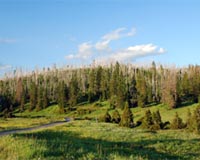
U.S. scientists have discovered dried mushrooms might be slowing climate warming in dry spruce forests in Alaska, Canada and Scandinavia.
University of California-Irvine researchers determined when soil in those forests and other northern areas is warmed, fungi that feed on dead plant material dry out and produce significantly less climate-warming carbon dioxide than fungi in cooler, wetter soil.
Assistant Professor Steve Allison, the study's lead author, said that came as a surprise to scientists, who expected warmer soil to emit larger amounts of carbon dioxide.
Knowing how forests cycle carbon is crucial to accurately predicting global climate warming. And, said Allison, that is especially important in northern forests, which contain approximately 30 percent of the Earth's soil carbon, equivalent to the amount of atmospheric carbon.
"We don't get a vicious cycle of warming in dry, boreal forests," said Allison. "Instead, we get the reverse — where warming actually prevents further warming from occurring. The Earth's natural processes could give us some time to implement responsible policies to counteract warming globally."
This study appears online in the journal Global Change Biology.
