
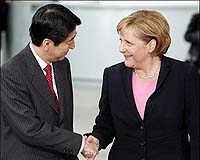
The European Union and Japan agreed on Tuesday to take the lead in forging a successor to the Kyoto Protocol, jointly proposing to halve greenhouse gas emissions by 2050. German Chancellor Angela Merkel, who holds the bloc's rotating presidency, and Japanese Prime Minister Shinzo Abe reached the accord during their meeting in Berlin on the eve of the Group of Eight summit.
Climate change is expected to be high on the agenda for the three-day G8 summit, which will be held in the Baltic resort of Heiligendamm starting on Wednesday.
"The EU and Japan are committed to take strong leadership towards the development of a fair, flexible, effective and comprehensive UN post-2012 framework that ensures the participation of all major emitting countries," the two sides said in a joint statement.
The 1997 Kyoto Protocol, named after Japan's ancient capital, is the world's first treaty mandating emission cuts and will expire in 2012.
The EU and Japan "are united in the view that a long-term goal for reducing global greenhouse gas emissions by half or more by the year 2050 needs to be established," they said.
While the EU and Japan insisted that developed countries should play a vital role in fighting global warming, they also called for a "fair contribution" by developing countries.
"We have to take action under a UN framework so that all members of the international community can participate bindingly," Merkel told a joint news conference with Abe.
"As this year's host country of the G8, Germany wants to keep step with Japan, which will host next year's summit," Merkel said.
Abe replied: "It is inevitable to create a practical framework in which the US, China and India should take part. Starting tomorrow (Wednesday), we would like to have full discussions with other G8 partners on the issue."
Asked if the United States can share the ambitious EU-Japan initiative, Merkel said: "At the G8, we will take a step forward from today's situation. Negotiations are still going on."
Abe said: "It's time to find not differences but common points, and it is important to solidify them."
Ahead of his departure from Tokyo early Tuesday, Abe said the Asian power would use its clout to act as a go-between in the fraught debate on climate change.
"The European Union and the United States still remain divided" over their positions on climate change, he told reporters.
"That is why Japan has to take the initiative to lead all the countries in one direction that they can basically accept. I feel that is our important responsibility."
Japan, the host nation of the Kyoto Protocol, has tried to take a high profile in the fight against climate change in line with its aspirations for greater global influence.
Ahead of the G8 summit, Abe called for all nations to agree in principle to halve greenhouse gas emissions by 2050.
But Japan has rejected a German proposal to set a 2009 deadline to close negotiations on the Kyoto Protocol's successor, saying it would be premature before major emitters such as the United States, China and India come onboard.
The United States has refused to ratify the treaty, arguing it is unfair as it makes no demands on fast-growing emerging economies such as China, which is set to overtake the US as the top air polluter.
Source: Agence France-Presse
