
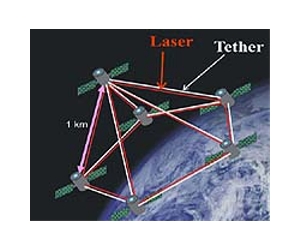
Tethers have been used in space for decades. They can help spacecraft to fly in close formation, as some surveillance satellites do. They can allow satellites to dip into the upper atmosphere, transfer momentum to each other, or spin around. Boffins have been generating exotic plans for tethers in space for a long time. Unfortunately, it's hard to see much actually happening.
It's clear that tethers in space are not really needed for most space missions. However, they still have their uses, and we should have expected a few more tethered satellites by now.
Tethers can be tricky devices. They snag. They break. They can become entangled in things. They can misbehave in various ways, and attract electrical charge. Several experiments with tethers in space have run afoul of these problems. A large experiment flown on the space shuttle failed to deploy to its full length.
Other problems occurred during a sub-satellite deployment from a Russian Foton spacecraft. Interestingly, one Gemini mission, with two astronauts aboard, managed to spin with a tether attached to another rocket stage!
There's a lot of debugging to be done. Engineers need to look at the composition of the tether, mechanisms for storage and deployment, as well as how suitable they are for certain missions. Work is taking place in these areas, mostly without a lot of attention. In the long term, it should all pay off.
We could use tethers to help de-orbit spacecraft, boost spacecraft to higher orbits, or even generate artificial gravity. Tethers can even be used as electromagnetic devices in the Earth's magnetic field.
A few more fundamental experiments in tethers would certainly be useful in the years ahead. Small ones could be deployed from small satellites, where they will not pose any risk to the International Space Station. Gradually, we could work our way up to longer, stronger tethers.
This is a basic area of technology that needs to be addressed more in the future. It's about time that spaceflight planners added some more tether missions to their plans.
