
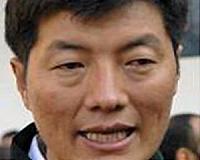
Thousands of exiled Tibetans worldwide voted Sunday in an election for a political leader to sustain their struggle for greater freedom in China and head their exiled government.
Harvard-educated Lobsang Sangay, current prime minister of the exiled government who is standing again for the top job, is the front-runner ahead of four other candidates.
But rival candidate and former political prisoner Lukar Jam Atsok threatens to make waves, advocating Tibet's complete independence from China rather than the exiled government's stance of greater autonomy.
"I think all Tibetans love the idea of freedom (called) Rangzen, but some are also scared of the idea or the person who is standing for it," he told AFP after voting in India's northern hill station of Dharamsala.
In Sunday's preliminary round of voting, 87,000 exiled Tibetans in 13 countries from Australia to the United States are registered to cast ballots for a prime minister and for a new exiled 44-member parliament.
Monks, nuns and families waited in long queues to vote at the main temple in Dharamsala where the exiled government is based.
Zompa, an 85-year-old grandmother, said she would again vote for Sangay. But student Pho Nya said the younger generation was drawn to Atsok, who fled Tibet in China after being released from jail in 1997 for political activism.
"He is a learned man and someone who has undergone suffering at the hands of the Chinese and overcame it," the 23-year-old said.
Election commission official Tenzin Choephel told AFP that turnout was high in Dharamsala, while the government in exile reported on its website that Tibetans "came out in strong numbers to vote" worldwide.
A final round of voting is scheduled for March next year when the new prime minister and parliament will be announced.
The election is only the second since the Dalai Lama retired as political head of the exiled government four years ago, handing over power to elected leader Sangay to continue the fight after his death.
The 80-year-old remains the spiritual head of Tibetan Buddhism and the figurehead of the struggle for autonomy for Tibetans in China.
But the Dalai Lama raised concern among his millions of followers last month when he scrapped a tour of the United States for health reasons.
The leader fled Tibet for exile in India in 1959 amid an abortive uprising against China's rule.
China has widely been seen as waiting for the Dalai Lama's death, believing that the movement for Tibetan rights would not survive without its charismatic and globally famous leader.
The Dalai Lama, an avowed pacifist, says he recognises China's rule over Tibet and is merely seeking greater freedom and autonomy.
China insists that the Nobel Peace Prize winner is a "splittist," and some younger Tibetan activists in exile have advocated a more militant approach.
Lessons in art from China's Xi in new book
Beijing (AFP) Oct 19, 2015 –
China's ruling party has compiled a book based on a call by President Xi Jinping for art to serve communism, state media reported Monday, heightening concerns among free speech advocates over artistic restrictions.
Xi's speech last year, urging artists not to chase popularity with "vulgar" works but promote socialism instead, drew comparisons to a 1942 address by China's communist founding father Mao Zedong insisting that culture should have an appropriate political purpose.
"Art and culture will emit the greatest positive energy when the Marxist view of art and culture is firmly established and the people are their focus," read a transcript of the speech released by the official news agency Xinhua last week.
The text has now been edited, with some widely reported controversial elements removed, and previously unreported supposed passages added, including a list of more than 100 foreign cultural figures Xi found inspiring, among them Wagner, Tolstoy, Victor Hugo, Jean-Paul Sartre and Ernest Hemingway.
The book's chapter titles include "Strengthening and improving the Party's leadership over artistic practice" and "The achievement of a great rejuvenation of the Chinese nation requires a prosperous flourishing of Chinese culture", state broadcaster CCTV reported.
The ruling party's publicity department issued a directive urging local authorities to organise seminars and classes to teach the book's contents, Xinhua reported.
Chinese authorities maintain a wide-ranging system of censorship that reaches deep into the media and online networks, and Hu Jia, one of China's most outspoken dissidents, said the renewed emphasis on Xi's text augured badly for free thinkers.
Xi was targeting the arts as a means of "undetectable control", he told AFP.
"The Communist Party is emphasising the importance of culture, but it's a socialist culture — it is not a free culture of democracy and rule of law," he said. "What the Communist Party is promoting, it's not culture or art — it's all propaganda."
Soft power is increasingly important to China as it attempts to expand its influence abroad, but campaigners say the process will be difficult without allowing creative freedoms.
Hu added: "As long as you come out with a voice that's different from theirs, it doesn't matter whether it's poetry, painting, movies, television, or any other artistic practice — it's likely the political police and then the jails that will await you."
