
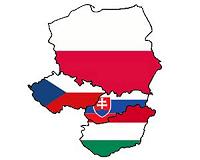
Four former Soviet satellites in Central Europe signed a military pact Friday to coordinate defence planning and to create a joint combat unit to operate under NATO and EU auspices, in response to the Ukraine crisis.
"The current situation in Europe shows that unfortunately a military conflict, previously considered unthinkable, could happen," Polish Defence Minister Tomasz Siemoniak said at a meeting of the Visegrad 4 (V4) group of countries — the Czech Republic, Hungary, Poland and Slovakia.
Speaking in Visegrad, Hungary, he said the Ukraine crisis showed the importance of "more dynamic cooperation" between the V4 countries within NATO and the European Union.
The "V4-EU" combat unit would only be ready to take part in NATO or EU operations by 2016, however, he said, adding that V4 military cooperation was "unique" within the NATO miliary alliance.
Europe's defence capabilities can be "improved," he told a news conference.
Hungarian Defence Minister Csaba Hende said that the joint body would comprise 3,000 soldiers contributed by the four countries.
"It would operate as a regional unit within NATO or EU operations," he added.
Friday's deal, signed by the defence ministers of all four countries, also included commitments on joint military exercises and defence spending coordination.
The V4 group was set up in 1991 as a forum for its members — all former communist countries and current EU members — to discuss common security and energy issues.
Hungarian Foreign Minister Janos Martonyi said Thursday that the V4 members are particularly "vulnerable" to the Ukrainian situation, would be hurt by EU sanctions against Russia and would expect "solidarity" from other EU member states.
Poland, Slovakia, and Hungary all have borders with Ukraine as well as significant minorities living there, mostly in the western part of the crisis-wracked former Soviet state.
UN resolution on Crimea: Russia vetoes, China abstains
United Nations, United States (AFP) March 15, 2014 –
Russia vetoed a Western-backed resolution condemning the Crimea referendum at a UN Security Council emergency vote Saturday, but China abstained, isolating Moscow further on the Ukraine crisis.
The draft resolution, which says Sunday's referendum would have no validity, got 13 votes in the 15-member council. But it was rejected when permanent member Russia exercised its veto.
The resolution declares that the referendum on whether the semi-autonomous region should come under Kremlin rule "cannot form the basis for any alteration of the status of Crimea."
China often backs Russia at the council, especially on Syria-related votes, and Western powers presented its abstention as the best possible outcome from the seventh UN emergency session since the crisis began.
"Russia, isolated, alone and wrong, blocked the resolution's passage," US ambassador Samantha Power told the council.
"This is a sad and remarkable moment."
US national security advisers assembled at the White House to discuss Ukraine. President Barack Obama was not there but was being briefed, a senior US official said.
"Russia totally isolated at UNSC. 13 vote for Resolution. Even China abstains. Russia alone in refusing to affirm sovereignty of #Ukraine," US Deputy National Security Adviser Ben Rhodes tweeted.
It came as Ukraine accused Russian forces of invading a southeastern region of the country that neighbors Crimea.
Thanking the UN for its efforts, Kiev warned the world the situation on the ground had suddenly got worse.
"This is something which changes the situation dramatically," Ukraine's ambassador to the UN, Yuriy Sergeyev, told reporters.
The United States was looking into the reports but would see any new Russian troop movement in south Ukraine as an "outrageous escalation," Power warned.
"For something additional, even more escalatory to have occurred would be flying in the face of everything you have heard here today," she said.
The Security Council session, which lasted more than an hour, degenerated into the usual recriminations between Western powers and Ukraine stacked up in one corner, and Russia in the other.
Russia's veto had been certain after last-ditch talks between US Secretary of State John Kerry and his Russian counterpart Sergei Lavrov broke down in London on Friday.
"It is a secret to no one that the Russian Federation will vote against the resolution," Russian Ambassador Vitaly Churkin told the council before the vote.
He defended Crimea's referendum as necessary to fill the "legal vacuum" that arose "as a result of an unconstitutional coup d'etat in Ukraine."
He later singled out Ukraine for "going beyond" permissible rhetoric, France for failing to mention alleged killings in Russian-speaking Ukraine and the United States for its "PR."
"Madam Power spoke of truth. Was Washington telling its truth about its role in the development of the crisis?" he thundered.
"Why are you negating the right of the people in Crimea to express their will in the referendum tomorrow?"
– 'A sad day' –
France, like Ukraine, harkened back to the days of the Cold War.
French Ambassador Gerard Araud told reporters that the impending annexation of Crimea was "totally unacceptable."
"It's a sad day, really, because we have the impression to go back 30 or 40 years," he added.
British Ambassador Mark Lyall Grant demanded Russia work to find a peaceful solution and "take notice of its isolation."
"If Russia fails to respond to Ukraine's outstretched hand, it will lead to further escalation of tension in the region and further consequences for Russia," he said.
The United States had drafted the resolution in very measured terms so that it could be accepted by Beijing.
Chinese Ambassador Liu Jieyi justified Beijing's abstention by saying that passing a resolution at this moment would "only result in confrontation and further complicate the situation."
"China has always been fair and objective. We will continue to mediate and promote dialogue so as to play a constructive role in seeking a political solution to the crisis," he said.
Beijing has long defended the need to respect territorial integrity and does not back interference in the internal affairs of other countries.
When the Security Council ruled on a similar international crisis, between Russia and Georgia in 2008, Beijing abstained.
