
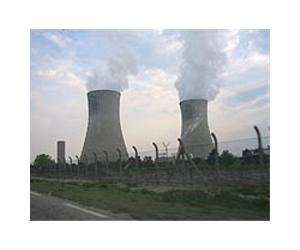
Prime Minister Francois Fillon on Thursday asked the country's top nuclear safety body to inspect all of France's reactors by year's end in the aftermath of the Fukushima accident.
"I ask you to carry out a study of safety at nuclear installations, in priority nuclear reactors, in the light of the ongoing accident at the Fukushima plant," Fillon said in a letter to Andre-Claude Lacoste, head of the Nuclear Safety Authority (ASN).
The government expects "preliminary conclusions" by the end of 2011, the letter said.
Three of the six reactors at Fukushima suffered partial meltdowns after the March 11 quake and tsunami struck northeastern Japan, and two pools holding spent fuel rods have run dangerously short of water.
A radioactive plume, caused by blasts and fire at the plant, is encircling the globe at high altitude, triggering fears of a disaster with long-lasting consequences.
The inspection will look at five factors: the risks from flooding, earthquakes, loss of electrical power and loss of cooling and the state of "operational management of accident situations".
France is proportionately the world's biggest user of nuclear power, under a huge construction programme that was launched after the oil shocks of the 1970s.
It has 58 reactors in 19 power plants providing around 75 percent of its electricity needs, the highest of any country. Only the United States has more reactors.
Separately, Ecology Minister Nathalie Kosciusko-Morizet said the inspection would be "more extensive" and "more transparent" than France's previous safety checks.
She did not rule out closure of a reactor if it carried a "major risk".
"We are carrying out this audit to respond primarily to the question that the French public is asking, and I understand why it is a source of distress: Is the same thing possible in our country?" Kosciusko-Morizet told AFP.
She added: "When it comes to transparency, France hasn't always been exemplary. It learned a lot from Chernobyl."
In the 1986 Chernobyl disaster, the French authorities became a laughing stock when they declared the fallout from the stricken Ukrainian plant had stopped at the French borders.
In 2006, as the country embarked on a programme of next-generation reactors, the government sought to tackle doubts about openness by passing a law on "nuclear transparency and openness".
This notably transformed the ASN, until then a government agency, into an "independent administrative authority" with a wide scope of action and intervention on safety issues.
earlier related report
State of Japan's stricken nuclear reactors
Osaka (AFP) March 24, 2011 –
Japanese emergency crews have battled to stabilise the crippled Fukushima Daiichi (No. 1) atomic power plant that has sparked global fears of a large-scale radiation disaster.
The 1970s era plant was rocked by the 9.0-magnitude quake on March 11 and then hit by the 14-metre (46 foot) tsunami it triggered, cutting it off from the national electric grid and knocking out backup power systems.
This shut down the cooling systems needed to keep the fuel rods inside reactors, and spent rods in containment pools, from overheating and boiling off the water around them, then melting down and releasing large-scale radiation.
To stop a catastrophe, crews have doused the reactors and pools with thousands of tons of seawater from fire engines and concrete pouring trucks.
Hydrogen explosions have blown away or damaged outer containment buildings around the steel-and-concrete primary reactor containment vessels.
As the dousing continues, sending radioactive vapour into the sky, workers have laid new power lines to all six reactors and are working to relaunch the original cooling systems. Here is the latest known status of the six reactors:
— REACTOR ONE — Overheating caused a partial meltdown of the reactor core. A hydrogen blast blew away the roof and walls of the outer building.
The control centre has partial power and lighting again.
— REACTOR TWO — Also thought to have suffered a partial meltdown. Fuel rods in pool were fully exposed at one stage. The outer structure was damaged by the explosion of adjacent number three.
— REACTOR THREE — A hydrogen explosion badly damaged the outer building, and a partial meltdown is also suspected. The reactor is the only one to use a volatile uranium-plutonium mix. Black smoke billowed from the site this week. The control room has partial power and light again since Tuesday, and workers were trying to reconnect a water pump to the suppression pool.
— REACTOR FOUR — The plant was undergoing maintenance when the quake struck and there are no rods in the reactor core. However the spent fuel storage pool has been heating up, threatening to run dry. A fire has destroyed the roof of the outer containment structure.
— REACTOR FIVE — Under maintenance when quake hit. External, non-emergency power connection has been restored and cooling of the spent fuel pool has resumed. One water pump failed Thursday and was going to be replaced.
— REACTOR SIX — Also under maintenance when the tremor hit, emergency power generator and cooling functions have been restored.
Share This Article With Planet Earth
