
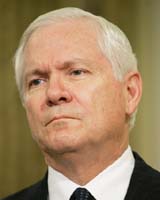
US Defense Secretary Robert Gates said Tuesday the United States was open to higher-level exchanges with Iran but urged greater realism about Tehran's intentions. "We should have no illusions about the nature of this regime — or about their designs for their nuclear program, their intentions for Iraq, or their ambitions in the Gulf region," he said.
In a speech to the American-Turkish Council here, Gates called on Iraq's neighbors to encourage political reconciliation and a reduction in violence in the country.
He said recent regional talks in Baghdad "were a good start toward improved cooperation, and our government is open to higher-level exchanges."
The March 10 talks included a rare face-to-face encounter between senior US and Iranian officials. Outgoing US Ambassador to Iraq Zalmay Khalilzad later said he briefly exchanged views with his Iranian counterpart.
Gates noted that before joining the Bush administration he had advocated for some dialogue with Iran.
"But in dealing with a regime like Iran's, one has to be realistic," he said.
He recalled joining then-national security adviser Zbigniew Brzezinski in a meeting in Algiers with Iran's political leaders shortly after the 1979 Islamic revolution.
He said Brzezinski offered to continue "the partnership that had previously existed under the Shah — including military assistance to the new revolutionary government," he said.
"Our interlocutors had only one demand: 'Give us the Shah.' And ultimately Zbig said that would be incompatible with our national honor," he said.
"Three days later came word that 66 of our diplomats had been seized in Tehran, and two weeks later, the prime minister and defense and foreign ministers with whom we had met were out of their jobs."
Gates comments came amid rising tension in the Gulf over the seizure on Friday of 15 British marines and sailors by the Iranian Revolutionary Guards navy.
Two US aircraft carrier battle strike groups began a two day display of force in the Gulf with war games involving fighter aircraft and surface warships.
A Pentagon spokesman denied the exercises were in response to seizure of the British. The aim was to "reassure our friends and our allies of our commitment to security and stability in the region," said Bryan Whitman.
Source: Agence France-Presse
