
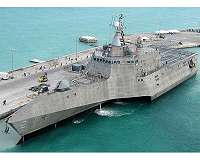
General Dynamics Land was awarded as $25.6 million contract for the production of MK46 modification 2 gun weapon systems for use on littoral combat ships and San Antonio-class landing platform dock ships.
The contract is for two 30mm MK46 MOD 2 GWSs for the surface warfare mission module on each LCS, the future Robert M. McCool Jr., which designated as LPD-29, and the planned LPD-30, as well as associated spare parts, the Defense Department announced Wednesday.
Sixty percent of the work will be performed at General Dynamics' Land Systems plant in Sterling Heights, Mich.; 25 percent in Anniston, Ala.; 7 percent in Lima, Ohio; 6 percent in Tallahassee, Fla., and 2 percent in Scranton, Penn. It is expected to be completed by September 2021.
Naval fiscal 2017, 2018, and 2019 shipbuilding and conversion funds, as well as fiscal 2018 and 2019 other procurement, and fiscal 2019 weapons procurement in the full amount of the contract has been obligated at time of award and will not expire at the end of the fiscal year.
The remotely operated system, which was first deployed in 2005, uses a 30mm high-velocity cannon for shipboard self-defense against small, high-speed surface targets, according to the U.S. Navy.
The system utilizes a forward-looking infrared sensor, a low light television camera and a laser rangefinder. The gun can be operated at the gun turret or remotely from the remote operating console in the Combat Information Center.
The MK 46 has a range of 4,400 yards, which can be extended with sub-caliber munitions. It can fire 200 rounds per minute from each of the two magazines.
A landing platform dock, also known as an amphibious warfare ship, embarks, transports and lands elements of a landing force for expeditionary warfare missions. The McCool's keel was laid down on April 12, with the ship expected for delivery in 2023.
The ship will be a transitional ship between the current San Antonio-class design and future San Antonio-class Flight II vessels. Flight II vessels are intended to replace the current Whidbey Island-class and Harpers Ferry-class dock landing ships. Each Flight II ship costs roughly $1.8 billion to build, according to the Congressional Research Service.
LCS ships are designed for near-shore and open-ocean operation to defeat asymmetric "anti-access" threats such as mines, quiet diesel submarines and fast surface craft.
The Freedom variant of the LCS is built by Lockheed Martin in Marinette, Wis., and the Independence variant is constructed by Austal USA in Mobile, Ala. The procurement cost for each new ship is $523.7 million according to the Congressional Research Service. Fifteen ships are under construction or in pre-production.
U.S. Navy names destroyer after Coast Guard hero Quentin Walsh
Washington (UPI) Jun 7, 2019 –
The U.S. Navy has named a future guided-missile destroyer in honor of Quentin Walsh, the first time an Arleigh Burke-class ship will honor a member of the Coast Guard.
Walsh, who died in 2000, was awarded the Navy Cross for his service during World War II.
"Capt. Walsh was a hero whose efforts during World War II continue to inspire, and his leadership in securing the French port of Cherbourg had a profound effect on the success of the amphibious operations associated with Operation Overlord," Secretary of the Navy Richard V. Spencer said Thursday at a ceremony aboard the U.S. Coast Guard Cutter Eagle in Cherbourg, France.
Spencer noted joint work with the Coast Guard.
"For over two centuries, the Navy and Marine Corps team and the Coast Guard have sailed side by side, in peacetime and war, fair weather or foul," Sencer said. "I am honored the future USS Quentin Walsh will carry Capt. Walsh's legacy of strength and service throughout the world, and I am proud that for decades to come, this ship will remind friends and adversaries alike of the proud history of our services and the skill and professionalism of all those who stand the watch today."
The ceremony was held on the 75th anniversary of D-Day in France.
"Naming a future Navy destroyer after Capt. Walsh, the first Arleigh Burke-class ship to be named after a Coast Guard legend, highlights not only his courageous actions but the bravery of all U.S. service members involved in the D-Day invasion of Normandy," Adm. Karl Schultz, the commandant of the U.S. Coast Guard, said at the ceremony.
He added, "we will remain always ready to stand with our brothers and sisters in the U.S. Navy and Marine Corps."
Walsh, who was serving on the staff of the commander of U.S. Naval Forces, Europe, was given command of a 53-man special task force assigned to capture the vital port of Cherbourg. His small force seized the port facilities and took control of the harbor the next day. There were heavy casualties.
Then Walsh, under a flag of truce, persuaded the commanding officer of the remnants of the 700-member German garrison at Fort du Homet to surrender after holding 52 U.S. Army paratroopers as prisoners. Walsh had exaggerated the strength of the forces under his command.
The future USS Quentin Walsh, which is designated as DDG 132, is designed to fight air, surface and subsurface battles simultaneously.
Arleigh Burke-class destroyers' operations include peacetime presence and crisis response at sea control.
The USS Quentin Walsh will be constructed at Bath Iron Works, a division of General Dynamics, in Bath, Maine. The ship will be 509 feet long with a beam of 59 feet and capable of operating in excess of 30 knots.
The class of ships typically include a crew of 329.
Ten Arleigh Burke-class destroyers are under construction and the Walsh is among 12 under contract, according to the U.S. Navy.
