
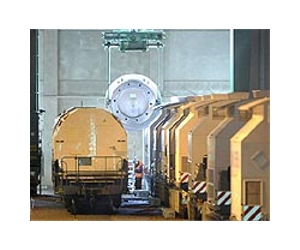
German radiation protection officials said Friday that all 126,000 barrels of nuclear waste stored since the 1970s in an unstable and leaking former salt mine would have to be removed as soon as possible.
"This is the best option for dealing with the radioactive waste stored there," said Wolfram Koenig, head of the Federal Office for Radiation Protection (BfS), which made the recommendation.
The Asse II mine in central Germany, used to store waste from 1967 to 1978 between 500 and 700 metres (1,640 and 2,300 feet) underground, has been known for some time to be leaking and in danger of partial collapse.
There is no full record of what the mine and its 13 shafts, dubbed a "ticking time bomb" by pressure group Greenpeace, could contain. Last August it emerged that it included 28 kilos (62 pounds) of highly toxic plutonium.
At first the barrels were stacked in an orderly manner, but in the 1970s they were simply dumped in and covered with the salt grit, with the result that many are now corroded and dented, according to press reports.
Extracting the waste is therefore expected to be a laborious, hazardous and expensive operation, with press reports saying it could take 10 years and cost as much as four billion euros (5.8 billion dollars).
Koenig said the operation would be a "great scientific and technical challenge," with the BfS planning to present soon a concept on how best to proceed.
The office also considered moving the waste to 1,000 metres underground at Asse or filling the mine with water and sealing it, but removing it was seen as the safest option for the long term.
"Since the long-term safety — and the safety of future generations — is of the utmost importance, and because this can only be assured through removal, this was seen as the best option," the BfS said.
It is also preparing "emergency measures" in case of an enormous increase of flooding, and if it is determined that some of the containers are dangerously corroded, then removing them will be reconsidered, it added.
The German section of Friends of the Earth, BUND, said it was unclear where the waste, which takes thousands of years to become safe, will go once extracted from Asse.
Press reports said that it would be stored in an old iron ore mine called Konrad Shaft near Salzgitter, which would then become Germany's first permanent storage site for nuclear waste.
Nuclear power is highly unpopular in Germany, and opponents have jumped on the parlous state of Asse and the lack of a permanent storage site in Germany as a reason to abandon it entirely.
Germany decided in 2000 to mothball its 17 reactors by 2020, but Chancellor Angela Merkel's government wants to look at extending the life of some plants, which produce around 30 percent of German power.
Share This Article With Planet Earth
