
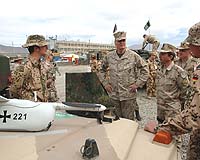
German troops could be out of Afghanistan within five to 10 years, Defence Minister Franz Josef Jung said in a television interview broadcast on Wednesday.
Asked on German rolling news channel N24 whether troops would leave the war-torn country by 2020, Jung said: "I assume so. In five to 10 years – that is my message."
"The quicker we push forward with training (Afghan police and security forces), the quicker we will achieve our goal," added the minister.
He said he was "utterly convinced" that the Allied strategy would lead to success.
"And success means that Afghanistan must be in a position to look after its own security. That is our goal."
Some 3,700 German troops are fighting in Afghanistan, where they form part of the 60,000-strong International Security Assistance Force led by NATO and made up of troops from 42 nations.
The mission is extremely unpopular in Germany and 35 troops have died since 2002 despite being based in the relatively peaceful north of Afghanistan.
In the most recent incident, three soldiers aged 21-23 died last week when their armoured vehicle overturned while reversing during a firefight with insurgents near the northern town of Kunduz.
Germany's contingent is being raised to up to 4,400 ahead of Afghanistan's presidential elections in August.
earlier related report
Marine reinforcements in major Afghan op: Marines
US Marine reinforcements recently deployed to Afghanistan launched their first major operation against the Taliban in the southern province of Helmand early Thursday, they said.
Operation Khanjar (Strike of the Sword) involves nearly 4,000 US forces as well as 650 Afghan police and soldiers, said a statement from the Marine Expeditionary Brigade (MEB) in Afghanistan.
Involving about 50 aircraft, the operation would push troops into insurgent strongholds in the south in what officers on the ground said was the biggest offensive airlift by the Marines since Vietnam.
"What makes Operation Khanjar different from those that have occurred before is the massive size of the force introduced, the speed at which it will insert," Brigadier General Larry Nicholson said in the statement.
It would also see the troops remain in place "and where we stay, we will hold, build and work toward transition of all security responsibilities to Afghan forces," said Nicholson, MEB commanding general in Afghanistan.
Share This Article With Planet Earth
