
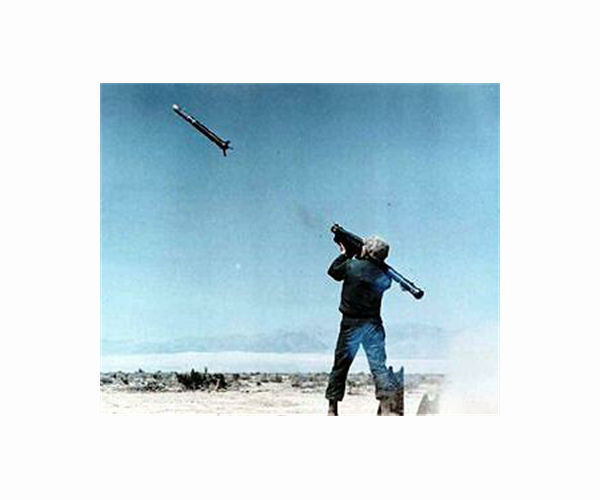
Germany will increase weapons deliveries to Ukraine following the Russian invasion by sending 2,700 anti-aircraft missiles to the conflict zone, a government source told AFP on Thursday.
The government "approved further support for Ukraine", involving the delivery of STRELA-type anti-aircraft missiles of Soviet manufacture, which were previously used by the army of communist East Germany, the source said.
Germany's first arms consignment of 1,000 anti-tank and another 500 anti-aircraft missiles has already been despatched to the front, the government said on Wednesday.
Another 18,000 helmets were also sent to Ukraine over the weekend, bringing the total number donated by Germany to 23,000.
"Further military equipment is ready to be sent," a defence ministry spokeswoman told AFP without giving details, noting that some items had yet to be approved.
The move came after Germany reversed its long-standing policy of not sending weapons to conflict zones, a position rooted in Nazi-era war guilt.
Allies had criticised Berlin for failing to support the Ukranian government with lethal weapons, having initially offered to send 5,000 helmets and build a field hospital.
On Saturday, Chancellor Olaf Scholz recognised that the Russian invasion represented a "turning point in history" that compelled Germany to rethink its priorities.
Germany has pledged to invest 100 billion euros ($111 billion) in the build-up of its own armed forces in the face of the Russian threat.
The government on Saturday also approved the delivery of German-made armaments to Ukraine from third countries, including 400 anti-tank rocket launchers via the Netherlands.
The government also unblocked the delivery of eight old howitzer cannons which Estonia had purchased from East Germany.
Egon Krenz, the former leader of the communist state, told the daily Berliner Zeitung in January that deliveries of east German weapons would "go against the spirit of reunification".
Spain to send 'military hardware' to Ukraine: PM
Madrid (AFP) March 2, 2022 –
Spain will supply weapons directly to Ukraine following Russia's invasion, Prime Minister Pedro Sanchez said Wednesday, two days after declaring Madrid would only contribute via an EU funding mechanism.
The move came after pressure on Sanchez's left-wing coalition government to take a more proactive approach to the war raging on Europe's eastern flank.
"Spain will give the Ukrainian resistance offensive military hardware," Sanchez said.
Defence Minister Margarita Robles told Antena 3 television that the hardware included 1,370 grenade launchers, 700,000 munitions and light automatic weapons.
The minister said the "material which can be used by people who don't have much experience in handling weapons" will leave Spain Friday morning on two planes that will land in an area of Poland "very close to the Ukrainian border and will be collected there by the Ukrainian authorities".
Sanchez previously said Spain would only supply offensive capabilities through the EU's European Peace Facility (EPF), a 450-million-euro ($500 million) funding mechanism activated on Sunday to provide military aid to Ukraine.
"We are going to transfer offensive material through this European peace mechanism fund… which we Europeans will be able to use to provide offensive material to Ukraine," he said in an interview late Monday.
A rising number of European states said they would send arms directly, prompting pressure from the right-wing opposition Popular Party, which urged Sanchez to "rise to the occasion" and not "hide behind the EU".
"We must respond to a European threat with a coordinated, united European response… and Spain responded immediately," Sanchez told parliament on Wednesday.
The United States, Canada and more than a dozen European countries have so far agreed to Ukrainian appeals for military equipment.
The announcement came a day after Spain said it would send 150 additional troops to Latvia as part of a wider NATO build-up in the Baltic region.
It already has 350 troops in place.
Sanchez said Russian President Vladimir Putin's decision to invade Ukraine was "a brutal attempt to stop the construction of a European space based on values radically opposed to the authoritarianism he represents".
