
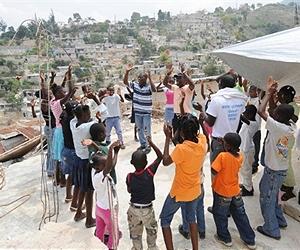
Faith is about all Haitians have left a year after an earthquake destroyed their country and on the last Sunday before the anguished anniversary, they flocked to praise God.
In Port-au-Prince, hundreds of Roman Catholics attended Mass under tents erected next to the cavernous ruins of the Cathedral of Our Lady of the Assumption.
Their prayers filtered through palm trees and over rubble. Men wore immaculately pressed long-sleeved shirts and the women crisp white and pink dresses, somehow kept free of the dust and dirt choking the capital.
All across the city similar scenes unfolded. Later Sunday, thousands flocked to a stadium to hear an American preacher, Franklin Graham, a star in the conservative US evangelical movement.
Haitians have long been known for fervent, rather idiosyncratic faith. A majority are Roman Catholic, but various Protestant churches have made strong inroads, while the deepest rooted faith here may be in voodoo.
On the eve of Wednesday's anniversary of the January 12, 2010 earthquake that killed more than 220,000 people and made homeless more than a million, Haitians say they are more devout than ever.
"The earthquake increased faith for many people. Many returned to their faith," said Franceeur Roland, 32, a plumber attending the open-air Mass at the cathedral.
Asked what was he was praying for, Roland, wearing a white coral necklace, answered: "That this doesn't happen again."
The pastel pink and white outer walls of the cathedral still stand but inside is a scene of terrifying destruction. Giant pillars lie tossed over mountainous heaps of rubble. Pieces of stained glass — blue, red, gold — wink from the dusty debris.
Eder Charles, a gatekeeper at the cathedral complex, said the entire choir, which had been in rehearsal, was crushed and that bodies still lie under the rubble. Haiti's Catholic archbishop was among the other victims that day.
Charles's prayer, he said, was for "something to change." What? "Everything. We are praying for the country to change."
At the city stadium, preparations were being completed to welcome Franklin Graham, son of Reverend Billy Graham. Many Haitians have turned from Catholicism to the more participatory Evangelical movement specializing in large-scale, emotionally charged events.
Beatrice J. Delievre, organizing at the stadium, said religion helped her believe that the natural disaster visited upon her country, the mass deaths, and overwhelming poverty, were not cause for despair.
"If all Haitians were not killed on January 12, then there is hope. Those who died, this was their time. But for those alive, there is hope," she said.
What Haitians have lost faith entirely in are the human powers of their political class.
At the moment when Haiti most needs leadership, the country finds itself in yet another round of political turmoil, with candidates from a first round of presidential elections squabbling over who should enter the second round.
Many here blame a lack of political vision for the inability to put Haiti back on its feet.
Not only has there been almost no rebuilding, or restoration of services, but barely any of the rubble has been cleared from earthquake sites — including the collapsed presidential palace.
"Those are men and mankind is weak," Delievre, 29, said. "You can't put your trust in mankind, only in God. God can do everything."
Hapless Haiti: A timeline of misery
Port-Au-Prince (AFP) Jan 8, 2011 –
Haiti has been plagued by pestilence and natural disasters since a catastrophic earthquake a year ago killed more than 220,000 people. Here is a chronology of the main events:
January 12, 2010:
– The 7.0-magnitude quake shakes Haiti at 4:53 pm (2153 GMT). Towns like Leogane and Jacmel are flattened along with large parts of the capital Port-au-Prince, where the presidential palace and key ministries collapse.
– January 14-15: After almost two days cut off from the outside world, the first international aid flights land at Port-au-Prince's badly-damaged international airport. More than 15,000 corpses have already been collected.
– January 16: US President Barack Obama calls predecessors George W. Bush and Bill Clinton to the White House and charges them with gathering funds for the mammoth reconstruction task that lies ahead.
– January 18: As fears over widespread looting and general lawlessness grow, the United States deploys up to 10,000 soldiers to maintain security and oversee the aid effort.
– January 19: US Marines descend by helicopter to take control of the ruined presidential palace as the aid effort gathers pace and supplies begin to reach those most in need.
– January 20: Elisabeth, a 23-day-old baby, is rescued from the ruins of a house in the devastated town of Jacmel in southern Haiti after spending seven days trapped with nothing to eat or drink.
– January 30: Ten American missionaries are arrested attempting to take 33 Haitian children across the border into the neighboring Dominican Republic without the necessary paperwork.
– February 27: Flooding kills at least 10 people in the southwest of the country, which was largely spared quake devastation.
– March: A week of heavy rain causes widespread flooding in the tent cities that have sprung up around the capital to house the estimated 1.3 million people left homeless by the quake.
– March 31: United Nations member states and international partners pledge 5.3 billion dollars for the next 18 months to begin Haiti's path to long-term recovery and almost 10 billion dollars overall.
– May 17: Capping a 108-day ordeal, a judge frees the head US missionary accused of trying to smuggle out the 33 Haitian children.
– June 1: The US military ends major relief operations in Haiti.
– October 18: Floods submerge much of Port-au-Prince, leaving 13 dead.
– Mid-October: The country's first cholera epidemic in more than a century erupts in a central river valley. By the year-end more than 3,300 people will have died from the disease.
– November 5: Hurricane Tomas leaves a trail of destruction in the west of the country, killing 21 people and worsening the cholera epidemic.
– November 15-17: Three people are killed in riots targeting UN peacekeepers blamed for bringing cholera into the country.
– November 28: Haitians vote to choose a successor to President Rene Preval, who has served his maximum of terms and is widely unpopular due to slow pace of recovery since the quake.
– December 7: Protests erupt when preliminary results reveal Preval's handpicked protege has made it through to a run-off ahead of a popular opposition candidate — at least five people are killed.
– December 9: The electoral commission agrees to recount tally sheets, but weeks later Haitians still await final results and no decision has been made on who will contest the indefinitely delayed run-off.
– December 22: Authorities say at least 45 people accused of spreading cholera, several of them voodoo practitioners, have been killed by angry mobs since the epidemic began.
Share This Article With Planet Earth
