
Hundreds of animals have been added to the 2008 "Red List" of species threatened with extinction, according to a new edition of the authoritative index released Monday.
And hundreds of others have moved up the scale of endangerment toward the ultimate category from which there is no return: "extinct."
Amid the gloomy news on the survival status of Earth's living creatures were glimmers of hope, proof that conservation projects can help some species crawl back from the brink.
Overall, however, 38 percent of 44,838 species cataloged to date are listed as "threatened" with extinction: a quarter of all mammals, one out of eight birds, one out of three amphibians, and 70 percent of plants.
Here are some of the animals species highlighted in the new report, put out by the International Union for the Conservation of Nature (IUCN).
— The Tasmanian devil (Sarcophilus harrisii), a carnivorous marsupial found only on the Australian island for which it is named, has declined by 60 percent in only 10 years, ravaged by a terrible face cancer that spreads through contact. Listed as "endangered," its prospects as a species "are extremely bleak," according to Simon Stuart, chairman of the IUCN's Biodiversity Assessment Subcommittee.
— Holdridge's Toad (Incillus holdridgei) once thrived in the rainforests of Costa Rica, but has now been declared extinct. The toad has probably fallen prey to a virulent and mysterious disease called chytridiomycosis that has devastated hundreds of species of fresh-water amphibians worldwide.
— The Iberian lynx (Lynx pardinus), a medium-sized cat native to Spain and Portugal, has a total population of between 84 and 143 adults and is "critically endangered," meaning that it faces a very high risk of extinction. It is dying out because of human encroachment, and because its primary prey — the European rabbit — has been decimated by eradication programs. Disease, illegal hunting and road kill are also serious threats to the lynx's survival.
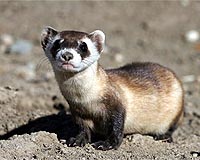
— The black-footed ferret (Mustela nigripes) disappeared from its native habitat in the prairies of North America in the 1980s, when it was listed as "extinct in the wild." Today, after a 20-year effort, it has been successfully reintroduced into eight US states and parts of Mexico.
— The rameshwaram parachute spider (Poecilotheria hanumavilasumica), a tarantula found in India, is now "critically endangered." Its habitat has dwindled to a single small island and part of the mainland less than 100 square kilometres (40 square miles), and its numbers have dwindled to some 500 adults.
— The purple marsh crab (Afrithelphusa monodoso) from upper Guinea in west Africa was virtually unknown to science until 2005, when the first living specimens were collected. These unusual, long-legged crabs live on land and in water, foraging by night and hiding in the shallow water that collects in their burrows at night. Listed as "endangered," it is under pressure from shrinking rainforests, which are being converted into agriculture land.
— The grey-faced sengi (rhynchocyon udzungwensis), a long-snouted elephant shrew from Tanzania, was discovered in 2005. Part of a group of mammals that evolved in Africa more than 100 million years ago — and whose evolutionary relatives include elephants — the sengi is listed in the less-threatened category of "vulnerable." But expanding human settlements are rapidly reducing its fragile habitat.
