
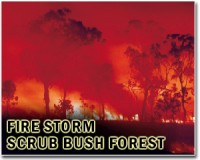
Massive bushfires across eastern Australia could be blazing for weeks, authorities warned Tuesday, as firefighters launched "Herculean" efforts to save homes from destruction.
More than 130 fires are raging in the states of Queensland and New South Wales, fuelled by strong winds and a prolonged drought, in an unusually ferocious and early start to the wildfire season.
Hundreds were evacuated after a fresh fire broke out on Queensland's Sunshine Coast, where video footage showed a huge blaze tearing through forests and glowing embers raining down.
About 1,000 firefighters battled through the night to contain the blazes across Queensland.
"Last night's Herculean efforts resulted in nothing short of a miracle," Queensland acting Premier Jackie Trad told reporters.
Just one home had been lost in the area, Trad said, but firefighters continued to battle the flames on Tuesday amid strengthening winds, supported by water-bombing aircraft.
In total, thousands of hectares of forest and dozens of homes have been destroyed, with most of the buildings lost in New South Wales.
Queensland Fire and Emergency Services acting commissioner Michael Wassing said the firefighting effort would continue "for days and weeks" due to the remoteness of some fires.
Bushfires are an annual occurrence in Australia during the southern hemisphere spring and summer, but scientists say climate change is exacerbating their strength and intensity.
Richard Thornton, CEO of the Bushfire and Natural Hazards Cooperative Research Centre, said unusually hot and dry conditions meant bushfires were expected but "it is the severity of the current bushfires that is most concerning".
"Without significant amounts of rain over a long period of time, we are looking at a long and dangerous fire season," he told AFP.
About eight of the blazes in Queensland are believed to have been "deliberately and recklessly lit" while some others had been accidentally sparked by children playing, police said.
A taskforce has been established to investigate the cause of the suspicious fires.
Australia girds for worst as bushfire season comes early
Sydney (AFP) Sept 9, 2019 –
Australia battled to contain around 160 bushfires in the east of the country Monday, an early start to a wildfire season that authorities warn could be the worst in decades.
Drought and strong winds have turned swathes of Queensland and New South Wales to tinder, prompting fires that have already damaged dozens of buildings and forced thousands of people to evacuate.
Australia's hot, dry climate makes bushfires a regular occurrence, but scientists say climate change is making conditions ever-more combustible.
Government-backed researchers have already predicted the next six months of southern hemisphere spring and summer have "the potential to be an active season" because of a very warm and dry start to the year.
Queensland Fire and Emergency Services assistant commissioner Brad Commens told AFP the early bushfire season had caught authorities off-guard.
Many of his staff would ordinarily be working on planning and preparation this early in September, but they have been called to action instead.
"At this point, we're fairly early in the fire season so it's difficult to predict how long this will go on for, but it's certainly not what I've seen over the last 30 years," he said.
"Without significant rain or without a significant weather change, I think we're in for the long haul."
The fire season usually starts in the far north of Queensland in September and slowly progresses down Australia's eastern states, hitting New South Wales around Christmas, and Victoria and Tasmania in January and February.
But it is already hitting southern Queensland and New South Wales — where there are 70 fires and 99 percent of the state was declared in drought last May.
On Friday, a fire tore through the small town of Tenterfield, destroying around 25 buildings including five houses.
The town's mayor, Pete Petty, told AFP it was "horrific" to see parts of the town burning. "The townspeople were in shock. It was like being in an apocalypse."
Like scientists, Petty fears this is just the beginning. "We're in the middle of the worst drought in living memory," he said.
