
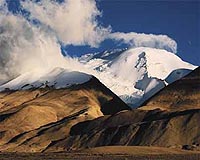
More is being spent on corporate and financial bailouts around the world than on promoting sustainability and addressing climate change, experts said at the "Kathmandu to Copenhagen" climate change conference.
Nepalese Prime Minister Madhav Kumar, in opening the two-day conference Monday in Kathmandu, noted that "despite the fact that the government is confronted with twin challenges like bringing the peace process to a logical conclusion and drafting the new statute within the stipulated time frame, we've given due diligence to this conference."
Talks focused mostly on the Himalayas, particularly the glaciers that provide headwaters for nine of Asia's largest rivers, ultimately serving the needs of 1.3 billion people.
The region "is a climate change hot spot that influences the lives of half the world's population," said a statement after the conference on Tuesday.
"Climate change in this region will affect peoples and ecosystems from the mountains to the coast to the sea."
"The South Asia region is highly vulnerable to the adverse impacts of climate change and is characterized by critical knowledge gaps, especially of mountain ecosystems within and across its constituent units," it said.
Although there were more than 200 participants from South Asia, including government officials, environmentalists and scientists, Nepal's former Environmental Minister Ganesh Sah said he was not optimistic about a consensus being reached because not all delegations were headed by ministers. Official representation included Nepal, Maldives, Sri Lanka and Bangladesh; noticeably absent were ministers from China and India.
Mohan Munasinghe, a vice chairman with the Intergovernmental Panel on Climate Change, called for a "sustainable development approach" to help reduce the impact of climate change on the Himalayas.
Each decade, for the last 30 years, temperatures in the region of the Himalayas have increased by between 0.27 and 1.08 degrees Fahrenheit.
According to scientists attending the conference, nearly 67 percent of the glaciers in the Himalayas have been retreating about 32 feet each year. As a result, some 68 of its lakes could burst at any time. Rising sea levels could disrupt economic activity for about 100 million people living in the coastal belt of South Asia.
"Water shortages will be the order of the day in the region if glaciers melt at the current pace," Purushottam Ghimire, joint secretary and chief of environment division in Nepal's Ministry of Environment, told Bloomberg. "Hydropower generation will start suffering in Nepal, India and then other countries."
Syed Iqbal Husnain, of the Energy and Resource Institute, who has been working on the Himalayas for years, said in addition to carbon dioxide, black carbon is causing ecological changes in the region.
Share This Article With Planet Earth
