
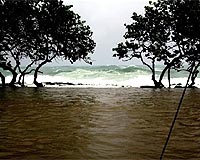
Killer Hurricane Ike moved out over open water Monday off Cuba's southern coast but continued hammering the island, as forecasters predicted a strengthening of the storm before it heads back over land toward the capital Havana.
The storm, which has left a trail of destruction through the Atlantic and Caribbean including 61 dead in Haiti, maintained Category Two status and winds near 160 kilometers (100 miles) per hour as it shifted west off Camaguey province and over the Ana Maria gulf, the US National Hurricane Center reported in its 1800 GMT bulletin.
"Some strengthening is possible during the next day or so while the system is over water," the NHC said.
Ike was about 405 kilometers (250 miles) east-southeast of Havana as of 1800 GMT, and with the NHC now forecasting the storm to hug the southern coastline and track further to the south of the city of 2.2 million people than predicted earlier Monday.
Cuban authorities however have put virtually the entire island under a hurricane warning, including Havana.
"In the sea it will intensify again," said Jose Rubiera, director of forecasting at Cuba's Institute of Meteorology. "Ike could reorganize over the warm sea waters."
The hurricane roared across Cuba Monday with torrential rain and gale-force winds, demolishing houses, crushing crops and, in the eastern town of Baracoa, sending seven-meter (23-foot) waves crashing into coastal buildings.
The NHC warned of storm surge flooding of up to three meters (12 feet) above normal along Cuba's southern coast and as much as 50 centimeters (20 inches) of rainfall in isolated places.
"These rains are likely to cause life-threatening flash floods and mud slides over mountainous terrain," the NHC said.
The storm has forced more than 1.8 million people — including more than 9,000 foreign tourists — to evacuate coastal or low-lying areas and head to shelters or to higher ground.
