
Luc Henkinbrant fought against the impunity of war criminals in the conflict-ridden east of the Democratic Republic of Congo for a decade.
Now the Belgian former UN human rights official dreams of turning the Lake Kivu island of Idjwi into a magnet for ecotourists.
He and his Congolese wife Esperance Mawanzo divide their time between the Belgian town of Liege and their little island paradise poking up through the lake's placid waters, ringed by the DR Congo's verdant mountains and the hills of neighbouring Rwanda.
Their Esperance (Hope) agency in Bukavu, on Lake Kivu's southern shore, aims to encourage tourism that respects both the environment and the local population.
Their clientele is drawn mainly from among expatriates working for Henkinbrant's former employer — the rights division of the UN peacekeeping force MONUSCO — and humanitarian groups working in the region.
– Coffee beans –
Setting off from the region's main city of Goma, the boat sails one and a half hours before reaching the first islets of an archipelago rich in vegetation including eucalyptus and bougainvillea.
Idjwi's peak is 2,300 metres (7,600 feet) above sea level, while the lake itself is already nearly 1,500 metres in altitude.
The couple greet visitors at a pier in the village of Bugaruva at the foot of a lush forest.
Once past a wary "migration" official — passports must be presented even for internal trips in the DR Congo — any anxiety begins to evaporate.
Here, there are none of the jeeps flying UN flags or bearing the logos of Goma's numerous aid groups.
In fact, four-wheeled vehicles are rare on the island's red dirt roads, reserved for VIPs such as the local "mwami" or traditional chief, while most people get around on motorbike taxis.
The lake island — Africa's second largest at 310 square kilometres (120 square miles), or about the size of Malta — is home to some 200,000 people.
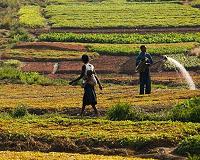
With its temperate climate varying from 20 to 25 degrees Celsius (68 to 77 Fahrenheit) all year round, Idjwi produces sweet potatoes and cassava — but especially, coffee.
The beans produced by more than 2,000 growers make their way to Starbucks cafes in the United States, their cooperative's president Gilbert Makelele told AFP.
– 'Potential is enormous' –
But islanders say their main asset is being a haven of peace in a region where dozens of armed groups have operated for decades.
"You can walk around all day on Idjwi without being hassled by armed groups or soldiers," Henkinbrant says.
Elsewhere in Kivu, the militias — many a by-product of the 1994 genocide in neighbouring Rwanda — sow terror, extorting and killing civilians, pillaging villages and raping women.
Their women victims are treated in Bukavu by gynaecologist Denis Mukwege, the co-winner of last year's Nobel Peace Prize.
A 15-minute motorcycle ride from the Bugaruva pier takes the visitor to Henkinbrant's compound with thatch-roofed bungalows offering mountain and lake views.
He is planning to set up more "ecolodges", eyeing the island's sandy beaches lapped by tepid waters.
"Idjwi's potential is enormous," Henkinbrant said, noting that people can enjoy walking, biking and kayaking as well as buzzing around the island on motorbike taxis.
– Darker side –
For tourists wanting to explore other sites in the region, Idjwi could be part of a trip taking in the Virunga National Park, home to the mountain gorillas made famous by US primatologist Dian Fossey.
The airports at Goma and the Rwandan capital, Kigali, are three hours away.
While Idjwi is the stuff of picture postcards, it does have a dark side.
The local Pygmy minority, which sells pottery to survive, lives on the edges of society, marginalised by the majority Bahavus.
And the main consequence of the 1994 Rwandan trauma for Idjwi was deforestation brought about by an influx of tens of thousands of Hutu refugees after the genocide targeting mainly ethnic Tutsis.
The island also remains underdeveloped, having yet to be connected to the national power grid and depending on generators for power — although the mwami saw to it that Wi-Fi came to the island three years ago.
Benin troops use force to clear protestors, casualties reported
Cotonou (AFP) May 2, 2019 –
Soldiers in Benin firing automatic rifles on Thursday broke up hundreds of protestors demonstrating against controversial parliamentary polls, inflicting casualties, an eye-witness said.
"They made a brutal incursion," said the witness, a close relative of former president Thomas Boni Yayi, who had led calls for a boycott of the ballot and whose house has become a focal point of protests.
"They fired bursts of bullets."
The witness said that three people were killed and that other protesters fled as soldiers open fire to disperse the crowds.
A video seen by AFP showed soldiers firing as protestors fled the gunfire.
The images showed some protesters lying on the ground, but it was not immediately possible to verify if they had been shot.
Large numbers of soldiers and riot police have been on the streets of Benin's economic capital Cotonou since Wednesday, hours after initial results showed a record low turnout in Sunday's election, in which no opposition candidates could take part.
Protestors erected makeshift barriers of burning tyres, and chanted slogans against President Patrice Talon.
They also torched businesses, hurled stones, and smashed the windows of government buildings. Police fired tear gas to break up crowds, and protestors tried to throw some canisters back.
A woman died on Thursday after being wounded the day before, medical sources said, and a man was brought to hospital with a gunshot wound in his back.
Violence was also reported in the town of Kandi, some 620 kilometres (385 miles) to the north, where one of the country's largest cotton factories — a sector in which President Talon made his fortune before embarking on politics — was set on fire.
The small West African state transited to democracy in 1990.
Its vibrant political scene has caused the country to be held up as a model, but rights groups say there is now a major risk of a return to authoritarianism.
