
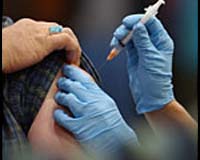
It is "vaccination by natural selection," lamented 51-year-old Cindy Rochen as she waited with thousands of others outside a clinic in this Washington suburb for a swine flu shot.
"You could be Stephen Hawking and you wouldn't get this flu shot if you didn't have an inside track to get inside that clinic," said Rochen, who walks with the aid of a cane, suffers from an autoimmune disease, a bone illness and asthma and can only have the injectable form of the vaccine.
The 200 doses of injectable vaccine that Montgomery County health officials had to hand on Wednesday for their third public H1N1 influenza vaccination campaign ran out within an hour of the clinic opening its doors.
"No more injectable," county immunization coordinator Mark Hodge shouted at around 10:00 am to anyone who could hear him in the crowd of at least 3,000 people.
A pregnant woman who had been waiting for two hours in the line that snaked around the vast car park and for several blocks down the suburban streets began sobbing.
A father accompanying his severely asthmatic daughter who had endured the long wait in the sun outside the clinic, filled in all the paperwork to get his daughter vaccinated and was at the front of line to go upstairs for the injection, nearly broke down.
"I told him, please don't. If you cry, we're all going to," said April, one of a dozen "medical screeners" weeding out those who could be vaccinated with the nasal spray from those who had to have one of the precious few doses of injectable vaccine: pregnant women, children under two, and people with certain chronic ailments, including severe asthma.
The nasal spray vaccine contains live but greatly weakened virus, while the injectable vaccine is made with killed H1N1 virus.
Montgomery County health officials had a total of 1,400 doses of H1N1 vaccine when the innoculation clinic began before 9:00 am Wednesday, and the bulk — 1,200 doses — was nasal spray.
While Health Officer Ulder Tillman got word that 2,000 additional doses of the nasal spray were being sent over from another clinic about 10 miles (16 kilometers) away, officials had no idea when the next batch of injectable vaccine would arrive.
"There are no more injectable clinics scheduled until we get more vaccine. We don't know when that will be," Hodge said.
Like the rest of the United States, Maryland is feeling the pinch of a shortage of H1N1 vaccine, caused in part by the barrage of tests the vaccine is subjected to, to ensure it is safe and effective.
The shortage was announced last week by the Centers for Disease Control and Prevention (CDC), which scaled back by a quarter projections for the number of doses that would be available by the end of October.
Earlier CDC projections had put the number of doses available at 40 million. Now, up to 30 million are expected to be available by the end of the month.
As the line grew outside the Rockville clinic Wednesday, US Health and Human Services Secretary Kathleen Sebelius was acknowledging to a Senate committee that demand for the swine flu virus was outstripping supply.
That was obvious outside the clinic, where thousands were waiting in vain.
Some had even slept in their cars to be sure they had a shot of getting a shot.
But those who needed the injectable vaccine and got to the clinic after 8:00 am — an hour before the vaccination drive was due to get under way — looked to be out of luck.
A heavily pregnant Heather Hoke, who is due to give birth next week, made it inside the clinic with three-year-old son, Jess, only to be told there was no more injectable vaccine.
"I'm very disappointed," she told AFP.
"Being in a high-risk category, I'd hoped there would be more available. My main concern is not about the safety of the vaccine, but that I am able to pass antibodies onto the newborn," she said.
Beth Williams, 35, whose baby is due in around eight weeks, had come to the clinic with her husband Kevin because "nobody has the vaccine anywhere — not my obstetrician, not my regular doctor."
Williams was still around 100 people back in the line when the "No more injectable" call went up.
earlier related report
US faces swine flu vaccine shortage
US health authorities on Wednesday acknowledged a swine flu vaccine shortage in the United States and, that manufacturers would likely not catch up until December.
US Health and Human Services Secretary Kathleen Sebelius told the Senate Homeland Security Committee that currently there is not enough H1N1 vaccine made to inoculate every American who wants to receive the shot.
"Right now we are at a point where the demand is ahead of the yield," Sebelius told lawmakers worried about the spread of the sometimes deadly disease and closely watching the US government's response.
Independent Senator Joseph Lieberman, the committee's chairman, noted that experts had previously forecast there would be 40 million doses available by late October but that expectations now were for roughly 30 million.
"There are now very unsettling reports of growing vaccine shortages," said Lieberman. "We're asking ourselves if enough vaccine will be produced in time for all who will need it as we continue to experience the spread of H1N1 flu."
At least 4,735 people have died from swine flu infections since April, when an outbreak of H1N1 flu was first reported in Mexico, the World Health Organization has said.
Earlier, US Homeland Security Secretary Janet Napolitano told CNN television that vaccine makers "will be caught up somewhere around December."
"This is a delay. It's not a shortage. There, ultimately, is going to be vaccine for everyone who wants to be vaccinated," said Napolitano, who urged Americans to take "common-sense" precautions.
"It's keeping your child home from school if he or she is sick, staying home from work yourself if you're sick. It's coughing properly into your arm, not into your hand. It's frequent hand washing.
"You know, those may sound kind of low-tech, which they are, but they're remarkably effective things when it comes to slowing the transmission of the virus," she said.
earlier related report
Merkel in row over 'government-only' swine flu jabs
A row in Germany over a "two-tier" swine flu vaccination programme has prompted Chancellor Angela Merkel to say she'll get the jab meant for the public rather than one reserved for "essential workers".
Criticism over "government-only" flu jabs, reserved for soldiers, policemen, and essential workers, comes against the backdrop of a nationwide immunisation campaign due to start next week.
The H1N1 virus has so far affected just 23,000 people in Germany, but the government is keen on vaccinating as many people as possible to avoid a possible large-scale outbreak at the start of the winter season.
But revelations in the press that top officials and other essential workers will get the Celvapan vaccine, manufactured by Baxter, which has fewer side effects than the mass Pandemrix vaccine manufactured by GlaxoSmithKline has caused a public outcry.
Government spokesman Ulrich Wilhelm has rejected accusations of a "two-tier medical system", saying both vaccines have equal worth.
Three vaccines — Pandemrix, Celvapan, and Focetria — have been approved by the European Union to fight the swine flu epidemic and "there isn't a 'better' or a 'worse' one", Wilhelm told a news conference Monday.
Merkel "will be seeing her regular general practitioner, will get his advice, and then will be vaccinated" with Pandemrix, the jab meant for the general public, Wilhelm added.
A number of newspapers nevertheless worried that the government was giving the appearance of double standards.
"How can an ordinary citizen understand that a vaccine with fewer side effects has been ordered for ministers than the one intended for the masses," asked the Frankfurter Allgemeine Zeitung.
Health ministry spokesman Klaus Vater explained that the government had ordered 200,000 vaccines from Baxter last year, in the wake of the bird flu scare, as a precautionary measure to protect essential workers from swine flu.
The government later ordered 50 million vaccines from GlaxoSmithKline to allow for the double dose vaccinations of some 25 million people in Germany, or about a third of the population.
The specialist for health matters at the social-democratic party, Karl Lauterbach, told the Stadt-Anzeiger newspaper that the Pandemrix jab was not recommended for young children and pregnant women because of possible side effects.
He also strongly criticized the government's information policy saying that the present row might lead people to forgo immunisation altogether.
Recent opinion polls here have suggested that Germans are not overly concerned about the flu which appears to have killed only two people to date in the country.
An Emnit poll said 59 percent of Germans had no fear of the flu.
The European Union recently warned against complacency over the spread of swine flu and urged people to get vaccinated even though the virus has not hit as hard as first feared.
"Even if the pandemic situation isn't so dramatic in Europe right now, we have to listen to the experts who say it's not time to lower our guard," said Swedish Public Health Minister Maria Larsson, whose country holds the EU presidency.
The swine flu has killed over 4,700 people in 191 countries and territories since it first appeared in the spring, according to the World Health Organisation.
Share This Article With Planet Earth
