
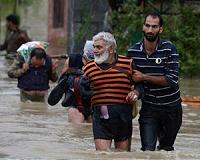
The main city in Indian Kashmir has "drowned completely" under floodwaters, a senior official said Friday, with the deadly inundation now affecting about two million people in neighbouring Pakistan and threatening its all-important cotton industry.
The floods began in Kashmir after heavy monsoon rains and are now progressing downstream through Pakistan, inundating thousands of villages and large areas of important farmland in the country's breadbasket.
More than 450 people have been killed and Pakistan's Disaster Management Authority (NDMA) said just shy of two million people have been affected by the floodwaters — a figure that includes both those stranded at home and those who fled after the floods hit.
More than 140,000 people have been evacuated from towns and villages around Punjab, Pakistan's richest and most populous province.
Authorities have made plans to blast holes in strategic dykes to divert the turbid brown floodwaters away from Multan, a city of two million inhabitants and the nerve centre of Pakistan's cotton and textiles industry, a vital export earner.
– 'Srinagar has drowned' –
Indian Home Minister Rajnath Singh said the floods were the worst to hit the mountainous territory in over a century.
As the waters began to recede, the extent of the devastation in Indian Kashmir's capital Srinagar was becoming clear.
"Srinagar has drowned completely, it's unrecognisable. Almost everything is in ruins, it is just unimaginable," Mehraj-Ud-Din Shah, State Disaster Response Force chief of Kashmir region, told AFP by phone.
He said work was "in full swing" to rescue people.
"But even now, around one lakh (100,000) people are believed to be stranded in different places," he said.
Indian-administered Kashmir's Chief Minister Omar Abdullah, who has come under fire over the slow pace of the rescue effort, said on Thursday the city had been "taken out", as he defended his government's performance.
"My government was totally inundated. I had no government for the first 36 hours," Omar told the Press Trust of India news agency.
"The establishment was wiped out. The state assembly building, the high court, the police headquarters and hospitals are all under water."
Nevertheless Sayed Ali Geelani, one of Indian Kashmir's best-known separatist leaders, made a swipe at what he branded the "pathetic" relief effort by the state and national governments.
"I want to congratulate the young people of our community for coming together and for the efforts that they have shown in the aftermath of these floods," the 84-year-old told supporters outside a mosque in Srinagar after attending Friday prayers.
"When a community has a youth such as ours, there is no power that can hold them back."
As Geelani spoke, a helicopter dropped food packages nearby which the gathered crowd began to rip up in anger.
Srinagar has also been hit by looting, leading some householders to risk their lives and stay with their homes to protect their property.
Jamal Ahmed Dar, who lives close to Srinagar's Dal Lake, said that his neighbours had already caught two looters red-handed.
"We came across and then caught up with two young men on a boat who we didn't recognise," he said.
"When we searched them, we found they had cash and other belongings that they couldn't account for. We gave them a bit of a slap, took the stuff back off them and then handed it over to the rescue coordinators."
An AFP correspondent witnessed two men on a raft made out of a plastic water tank trying to break into a house in the upmarket Jawara Nagar neighbourhood before they were chased away by locals who pursued them on a flimsy wooden boat.
– Fresh flood warnings –
Pakistan's Ministry of Water and Power has issued fresh flood warnings for the river Indus at Guddu and Sukkur, downriver from Multan in Sindh province.
The Sukkur area was badly affected by the devastating floods of 2010, the worst in Pakistan's history, when the waters swamped 160,000 square kilometres of land — an area bigger than England — and cost the country nearly $10 billion. Around 1,800 people were killed and 20 million affected.
Analysts have said this year's floods so far do not appear to be on the same scale, but thousands of people are still facing life in relief camps until the waters recede.
The Pakistani army, which often plays a leading role in disaster relief, said seven of its helicopters were engaged in rescue work around Multan and Jhang, upriver.
Troops have dropped more than 50 tonnes of rations around Punjab, the military said in a statement, and mobile medical teams are treating those affected by the floods.
burs-cc/pdh
