
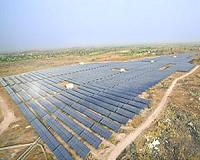
The Indian Space Research Organisation (ISRO) has developed an Android app that will show the solar potential of a given location in any part of the country. The app was developed to support the clean energy target of generating 175,000 MW power through non-fossil fuel energy.
The computation of solar energy potential is essential for selecting locations for solar photovoltaic (PV) thermal power plants.
"The use of remote sensing observations from geostationary satellite sensors is ideal to capture space-time variability of surface insolation. An Android app for the computation of solar energy potential has been developed by Space Applications Centre (SAC), ISRO, Ahmedabad at the behest of Ministry of New and Renewable Energy, Government of India. It is a very useful tool for installation of PV solar panels for tapping solar energy," an ISRO release said.
+ The app is available on the vedas.sac.gov.in website.
It will use data from Indian Geostationary Satellite such as Kalpana-1, INSAT-3D and INSAT-3DR for monthly and yearly solar potential (in kWh/m2) and minimum and maximum temperature at any location. It also provides azimuth and elevation angles, and day length over different time periods in a year.
Its Digital Elevation Model will be used to calculate obstruction of sunlight due to the terrain which is very important for vast areas in the Himalayan terrain. This Internet-based app will provide accurate results and the report can be saved as a PDF file.
India pledged before the United Nations Framework Convention on Climate Change to achieve 40% cumulative electric power capacity from non-fossil fuel based energy resources by 2030.
Solar cell design with over 50 percent energy-conversion efficiency
Solar cells convert the sun's energy into electricity by converting photons into electrons. A new solar cell design could raise the energy conversion efficiency to over 50% by absorbing the spectral components of longer wavelengths that are usually lost during transmission through the cell.
This research was carried out by a team led by Professor KITA Takashi and Project Assistant Professo … read more
