
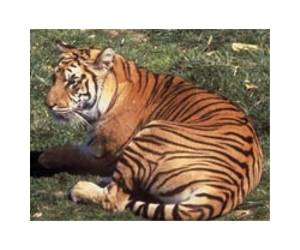
India's tiger population has increased for the first time in decades, a newspaper said on Saturday, citing a national tiger census report slated to be released next week.
According to the 2009-10 tiger census report, the number roaming India has jumped to 1,510-1,550 from 1,411 in 2004-05, The Indian Express newspaper said.
The newspaper report came ahead of an international tiger conservation conference due to open on Monday in the Indian capital New Delhi.
India is home to more than half of the world's rapidly dwindling wild tiger population, but its conservation programme, said by the government to be the world's most comprehensive, has been struggling to halt the big cat's decline.
Tiger conservationists welcomed the news and said that the population increase was due to the authorities surveying more areas to conduct the census and creating more tiger reserves.
Tito Joseph, programme director at the Wildlife Protection Society of India, said "the latest census included some of the areas they left out last time because of problems accessing the terrain, like the Sunderbans" which is home to hundreds of tigers.
The Sunderbans mangrove forest straddles the borders of India's West Bengal state and Bangladesh and lies on the Ganges-Brahmaputra delta.
"They have also set up more tiger reserves. In 2004 there were only 28-33 tiger reserves, now there are 39 reserves, so that's obviously helped," Joseph told AFP.
"It's a good strategy, because tigers need space above all, and if you can create inviolate space their numbers will naturally go up," he said.
The current tiger population still remains a long way off the numbers registered in 2002 when some 3,700 tigers were estimated to be alive in the country.
There were estimated to be around 40,000 tigers in India at the time of independence from Britain in 1947.
Authorities across Asia are waging a major battle against poachers and other man-made problems such as destruction of the tigers' habitat due to industrial expansion.
A major poacher trafficking route begins in India and ends in China where tiger parts are highly prized as purported cures for a range of ailments and as aphrodisiacs.
"Tiger skins fetch anywhere around 11,000-21,000 US dollars and bones are sold for about 1,000 US dollars in China," said Rajesh Gopal, chairman of National Tiger Conservation Authority in New Delhi.
earlier related report
Rare Sumatran tiger killed by electric fence
Jakarta (AFP) March 25, 2011 –
An endangered Sumatran tiger has died after brushing against an electric fence set up by Indonesian farmers, in the second such incident this year, an official said Friday.
There are fewer than 400 Sumatran tigers left in the wild and environmental activists say the animals are increasing coming into contact with people as a result of their natural habitat being lost due to deforestation.
The two-metre (six foot) male tiger was electrocuted on Monday in Jambi province in the centre of Sumatra, Indonesia's largest island, a provincial conservation agency chief, Trisiswo, told AFP.
He said it was the second time this year a tiger had died as a result of the electric fences installed by locals to protect palm oil plantations.
"The tiger's body was partly charred but unlike the first incident, the body was still intact," he said. Locals had sold some of the body parts of the tiger that was killed last month.
Trisiswo said people in the village of Air Laut Hitam village had encircled their palm oil plantations with the high-voltage electric wires to keep out wild animals and had refused to abide by local rules banning the practice.
"We reported the case to local police to act firmly against them and we'll cooperate with local administration to stop this dangerous practice," he said.
Share This Article With Planet Earth
