
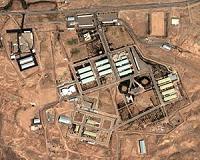
Iran will not give UN nuclear inspectors access to a military base outside Tehran that they have been seeking to visit since 2005, Defence Minister Hossein Dehgan said on Saturday.
Dehgan's comments come just two days before a deadline for Iran to give its response to the International Atomic Energy Agency (IAEA) over historic allegations of a military dimension to its nuclear research.
"The agency carried out several visits to Parchin (before 2005), took samples and found nothing untoward," Dehgan told the ISNA news agency.
"There is therefore no reason for new access to Parchin as nothing new has come up since the last inspections."
IAEA inspectors have been given access to a string of declared nuclear sites as part of an interim nuclear deal reached with the major powers last November.
Access to Parchin was not agreed under the terms of that accord but the IAEA has been seeking to visit the base as part of its mission to answer all concerns about Iran's nuclear programme, past and present.
Addressing the allegations, long denied by Tehran, would be an important element in the comprehensive deal on Iran's nuclear programme that world powers are seeking to reach by November 24.
IAEA director Yukiya Amano, who visited Tehran earlier this month, said in June that access to Parchin was essential for the watchog to be able to certify Iran's nuclear programme as peaceful.
The base lies at the centre of allegations of past Iranian research into sophisticated explosives that can be used to detonate a nuclear warhead.
In his June report, Amano said satellite photographs suggested there had been fresh activity at the base this year.
"Since February this year, we again start to observe activities… these activities continue," he said.
Iran has repeatedly refused the IAEA access to the base but "we keep on insisting to have access to that particular site in Parchin, to the people and to their documents," Amano said in the report.
Dehgan also said that his country refused to give the agency information on its scientists in the defence industry.
Iran FM due in Moscow ahead amid nuclear talks
Tehran (AFP) Aug 22, 2014 –
Iranian Foreign Minister Mohammad Javad Zarif will visit ally Moscow next week, the Islamic republic's ambassador to Russia wrote on Facebook Friday, media reports said.
Mehdi Sanaei said that Zarif will travel on August 29 to meet his counterpart Sergei Lavrov, saying only that their talks would focus on bilateral, regional and international issues.
However, Iran is currently engaged in negotiations with the five permanent members of the UN Security Council plus Germany — known as P5+1 — on securing an agreement with world powers on its controversial nuclear programme.
Iran and the P5+1 signed an interim deal last November and are in discussions to secure a more permanent accord.
The target date for a final deal has been put back to November 24.
By August 25 Tehran must also respond to the International Atomic Energy Agency (IAEA) on decade-old allegations of past nuclear weapons research.
Tehran denies it wants nuclear weapons, insisting it is pursuing atomic energy purely for peaceful purposes.
Last year's key deal partly froze Iran's nuclear activities in return for minor sanctions relief but the gap between the two sides remains large.
While some differences have been reconciled, disagreements remain over how much uranium Iran would be allowed to enrich and on the lifting of international economic sanctions.
A new round of talks between the two sides is expected before the UN General Assembly starts on September 16.
A historic accord would see Iran scale back its nuclear activities and in return Tehran would be granted relief from painful UN and Western sanctions.
Such a deal could finally put an end to a standoff that has been threatening to escalate into a war since 2002.
Russia and Iran are also engaged in talks on an agreement on exchanging Iranian oil for Russian goods and technology.
Negotiations of this contract are due to begin in Tehran on September 9.
Senior Russian officials have stressed that such deliveries do not go against the sanctions imposed by the UN on Iran over its nuclear programme.
Moscow is also subject to European and American sanctions for its support for the pro-Russian rebellion in Ukraine.
