
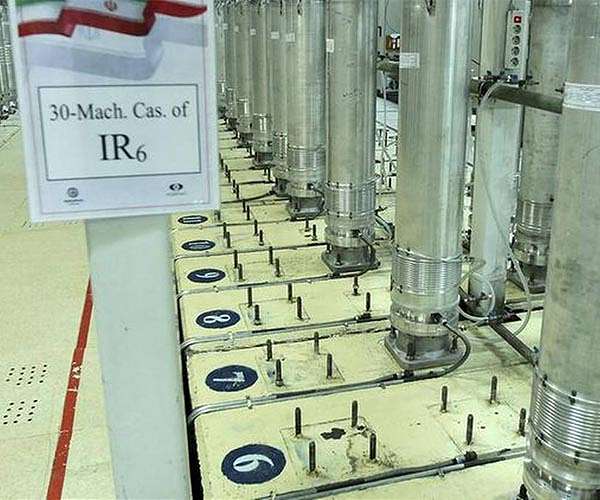
Iran said it has almost doubled its stock of enriched uranium in less than a month, as it prepares to resume talks with world powers on curbing its nuclear programme.
Tehran has progressively abandoned its commitments to a 2015 nuclear deal since then US president Donald Trump pulled Washington out in 2018, prompting Washington to impose fresh sanctions in response.
"We have more than 210 kilogrammes of uranium enriched to 20 percent, and we've produced 25 kilos at 60 percent, a level that no country apart from those with nuclear arms are able to produce," said Atomic Energy Organisation of Iran (AEOI) spokesman Behrouz Kamalvandi, quoted late Wednesday by state news agency IRNA.
In September, the International Atomic Energy Agency confirmed that Iran had boosted its stocks of uranium enriched above the percentage allowed in the 2015 deal.
On October 10, AEOI head Mohammad Eslami said his country had produced more than 120 kilos of 20-percent enriched uranium, in theory allowing the manufacture of medical isotopes used mainly in diagnosing certain cancers.
Iran was not meant to enrich uranium above 3.67 percent, well below the 90-percent threshold needed for use in a nuclear weapon.
The 2015 agreement with Britain, China, Russia, France, Germany and the United States, offered Iran some sanctions relief in return for curbs on its nuclear programme.
Nuclear negotiations between Iran and world powers are to resume on November 29. Iran has always insisted its nuclear programme is for peaceful purposes.
Timeline: Iran's troubled nuclear deal since Trump exit
Tehran (AFP) Nov 4, 2021 –
With talks on reviving a landmark 2015 agreement on Iran's nuclear programme poised to resume, we look at sanctions and brinkmanship since the United States pulled out of the pact in May 2018.
Here is a timeline:
– 2018: US withdrawal –
President Donald Trump walks away from the deal negotiated between Iran and the five permanent members of the UN Security Council — Britain, China, France, Russia and the US — plus Germany on May 8, 2018.
"We cannot prevent an Iranian nuclear bomb under the decaying and rotten structure of the current agreement," he says.
– US sanctions –
Later that year, Washington reimposes sanctions on Iran and companies with ties to it, badly hitting Iran's vital oil sector and central bank.
Major international firms halt activities there as the US bans other nations from buying Iranian crude.
– 2019: Iran starts walk-back –
In May 2019, Iran takes its first step away from the deal, aiming to pressure Europe into helping it circumvent the sanctions.
Trump hits back by sanctioning Iran's steel and mining sectors.
In July, Tehran says it has exceeded the accord's restrictions on both its enriched uranium reserves and enrichment levels.
– 10-fold increase –
In September 2019, the International Atomic Energy Agency (IAEA) watchdog says Iran has started using advanced centrifuges to enrich uranium.
In November, Tehran says its enrichment increased tenfold and that it has developed two new advanced centrifuges.
It then resumes enrichment at its Fordo plant.
– 2020: Drone assassination –
Tensions between Washington and Tehran spiral after a US drone strike in January kills top Iranian commander Qassem Soleimani in Baghdad, sparking a tit-for-tat confrontation.
Iran announces its fifth step back, foregoing a limit on its number of centrifuges.
– Iranian demands –
In February 2020, Iran demands economic advantages from Europe in return for cancelling all, or part, of its rollback measures.
In March, European signatories say they have delivered medical goods to Iran under a mechanism established to bypass US sanctions.
On November 27, one of Iran's top nuclear scientists, Mohsen Fakhrizadeh, is killed near Tehran in an attack that Iran blames on Israel.
– 2021: New breach –
With Trump in his last days in the White House and tensions spiralling, Tehran deals the accord a further blow on January 4 by saying it has resumed enriching uranium to 20 percent purity at Fordo.
The IAEA in February says Iran has started producing uranium metal, which can be used in nuclear weapons.
It is also "deeply concerned" by the possible presence of nuclear material at an undeclared site as Iran restricts inspections.
– 60 percent enrichment –
On April 7, with President Joe Biden in the White House, talks on rescuing the accord begin in Vienna.
But nine days later Iran says it will start enriching uranium up to 60 percent after an attack on its Natanz plant that it blames on Israel.
– Iran hits pause button –
Iran pauses talks in June after the election of hardline new president, Ebrahim Raisi.
But on August 5, he says it is again open to negotiations as experts warn nuclear work is continuing apace and advancing to dangerous levels.
– Tehran ready to talk –
On October 13, Washington raises the spectre of a military option as Europe presses Iran to rejoin the talks suspended since June.
On October 27, after a meeting in Brussels, Iran says it is ready to resume indirect talks in Vienna.
The US calls on it to show "good faith" when they start on November 29, saying a compromise could be reached quickly if Tehran is "serious".
