
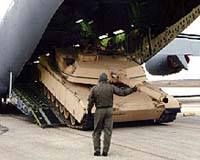
Iraq will receive 140 Abrams battle tanks from the United States to bolster its new forces, the US army said on Saturday.
The Iraqi army had taken "a major step in the force modernisation of its armoured units with the recent procurement of 140 M1A1SA Abrams main battle tanks," a statement said.
The tanks were due to arrive over 18 months in groups of 35.
Iraqi troops would begin training with US officers to operate the tanks in December 2010, the statement added. It gave no detail about whether the United States had sold or given the tanks to the Baghdad government.
Before the ouster of Saddam Hussein's regime in 2003 the Iraqi army had a fleet of mostly aging Russian T-72 tanks.
On January 1, some 260,000 Iraqi soldiers took over control of security operations in Iraq alongside the police after the UN mandate governing US-led forces deployed in the country expired.
Most US troops are due to be withdrawn from Iraq within 18 months.
earlier related report
Iraq says US to pull out 12,000 troops by September end
The United States will pull 12,000 troops out of Iraq by the end of September, Baghdad government spokesman Ali Dabbagh announced on Sunday, marking an acceleration of the US withdrawal.
"We have agreed that a total of 12,000 US troops will be withdrawn by the end of September 2009," he said.
Under a US-Iraqi security agreement signed in November during president George W. Bush's tenure, US troops are to withdraw from towns and cities by June 30 and from the whole country by the end of 2011.
Some 140,000 US troops are currently deployed in Iraq — down from a peak of about 160,000 during the "surge" offensive against insurgents and Al-Qaeda in 2007.
"The Iraqi government has no intention of keeping foreign forces in the country) after 2011," Dabbagh told a press conference.
"Iraq's armed forces are under construction," he added, standing next to coalition forces spokesman Major General David Perkins of the US army.
"We do not consider the Iraqi security forces are ready. Iraqi forces need to be equipped and trained, Dabbagh said.
"By 2011 they will be able to stand on their own. We are confident of the fact that the security agreement will be respected."
Perkins said the US forces would be reduced from 14 to 12 brigades.
The 12,000 men would be from two combat brigades, including the 4th brigade, 82nd airborne and marines battalions, as well as their support staff in the military police, engineers, logistics and transport.
An F16 squadron would be pulled out too and will not be replaced.
"We will not leave any seams with regard to security," Perkins said. "We know how to do this. This is not the first time we have done this."
US President Barack Obama has announced an end to combat operations in Iraq within 18 months, but details of withdrawals had remained sketchy.
US counter-terrorism and training forces numbering up to 50,000 are to remain in Iraq until a full withdrawal by the end of 2011.
"In addition, 4,000 British troops will withdraw in July 2009 according to an agreement between the United Kingdom and Iraq," Dabbagh said.
British Prime Minister Gordon Brown visited Iraq in December and announced his country's 4,100 troops would leave by the end of July, but their mission would already be complete "by the end of May, or earlier."
British forces on January 1 handed over control of Basra airport, its main military base in the south, to Iraqi officials. British troops had withdrawn from Basra city last September.
British troops have since been training the Iraqi army and after the full withdrawal, a small contingent of military advisors is likely to stay on in Iraq.
Security has improved dramatically in Iraq since late 2007 bringing a fragile stability, but attacks remain common in the capital, in confessionally divided Diyala province and around the main northern city of Mosul, which is split between Sunni Arabs, Christians and Kurds.
A suicide bomber on a bicycle blew himself up killing at least 28 people and wounding 58 more outside a police academy in the Iraqi capital on Sunday in the bloodiest attack in weeks.
On Thursday, a truck bomb killed 10 people and wounded more than 50 at a crowded livestock market near Hilla, a mainly Shiite provincial capital south of Baghdad.
That blast was the deadliest single attack in the country since a suicide bomber killed 35 pilgrims heading to the shrine city of Karbala south of Baghdad in February.
Some 258 Iraqis were killed in violence last month, a sharp rise from the previous month that saw the lowest casualty figures since the US-led invasion of March 2003, according to government statistics.
The February death toll was up 35 percent on January's total of 191, which was the lowest figure since 2003.
A total of 4,556 US soldiers have died in Iraq over the past six years as well as 179 British soldiers.
