
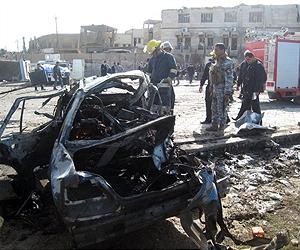
A car bomb killed 30 people and wounded 46 near a mosque in a predominantly Shiite area of the mixed city of Baquba, north of the Iraqi capital Baghdad, on Wednesday, security officials said.
The bomb in a car parked near a Shiite mosque in the Abu Sayeeda neighbourhood of the city exploded at around 6:00 pm (1500 GMT), an official from Baquba Operations Command said.
Police imposed a curfew in Abu Sayeeda as they suspect there might be more bombs, the official said, adding later that police had defused two roadside bombs in the area.
Also on Wednesday, a US soldier was killed by a homemade bomb in Diyala province, the US military said.
A total of 4,413 American troops have died since the US-led invasion of 2003 toppled now executed dictator Saddam Hussein, according to an AFP tally based on a running toll kept by the independent website www.icasualties.org.
Diyala, of which Baquba is the capital, is confessionally and ethnically mixed and has been a persistent target for attack by Al-Qaeda militants seeking to exploit its communal tensions.
On Monday, a bomb in a car parked in front of a coffee shop killed seven people and wounded 21 in the city, police said.
And on Tuesday, six Iranians and two Iraqis were wounded by a car bomb targeting a bus in Jadidat al-Shat to the west of the city.
US and Iraqi officials have warned of the dangers of an upsurge in violence as negotiations on forming a new governing coalition have dragged on, giving insurgent groups an opportunity to further destabilise the country.
More than four months after a March 7 general election which gave no single bloc an overall parliamentary majority, the two lists which won most seats are still bickering over who should be the next prime minister.
On July 12, Iraqi politicians extended an inaugural parliamentary session by two weeks to give rival blocs more time to form a government.
But on Wednesday, the top US commander in Iraq, General Ray Odierno, said that recent attacks, including a suicide bombing on Sunday that killed at least 45 people — Iraq's deadliest single attack in more than two months — would not affect the withdrawal timetable for US troops.
"I believe it is in the best interest of our mission" to keep the timetable. "It's important that we live up to our commitment."
US President Barack Obama has promised to scale back the US military presence to 50,000 troops by August 31 ahead of a full withdrawal in 2011.
US to draw down diplomats in Iraq in next 3-5 years
Washington (AFP) July 21, 2010 –
The United States plans to pare back its vast diplomatic presence in Iraq in the 3-5 years after the US military leaves at the end of 2011, the likely next US ambassador there has said.
But Jim Jeffrey, now US ambassador to Turkey and nominated to go to Baghdad, told lawmakers that in the short term Washington would need to do "a lot of diplomatic work" to get Iraq "fully plugged into" regional relationships.
And the United States will ultimately rely on an embassy in Baghdad, two consulates, and a special office to coordinate military sales and training of Iraqi security forces, Jeffrey told the Senate Foreign Relations Committee.
For now, as the US military moves to complete its withdrawal by December 31, 2011, Washington will collapse 22 civilian-military "provincial reconstruction teams" into the consulates and three embassy branch offices, he said.
The branch offices will have "very robust political reporting, economic and assistance activities, rule of law as well, human rights monitoring," and will take over an Iraqi police training program from the military, he said.
"The police training program, the State Department will pick up from the US military in October of 2011. We're looking at several hundred police advisers," he said.
"We see the three branch offices closing within three to five years and the police program also ending in roughly that time," said the diplomat.
The permanent US diplomatic presence will group the embassy in Baghdad, the two consulates, and an "embassy office of security cooperation" to be opened in 2011 "to help with training and equipping" Iraqi security forces, he said.
Jeffrey expressed optimism that Iraqi political leaders would resolve a four-month stalemate that has frozen efforts to form a government, saying past impasses in 2005 and 2006 had ended "after four to five months."
Share This Article With Planet Earth
