
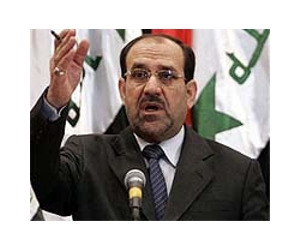
Prime Minister Nuri al-Maliki on Sunday failed to grasp first place in Iraq's parliamentary election from his arch-rival Iyad Allawi after a painstaking recount dismissed claims of massive ballot fraud.
Maliki, the incumbent Shiite premier, had alleged that he lost thousands of votes, but election commission officials told AFP that a 12-day manual count of ballots cast in Baghdad had shown no change from the original results.
Allawi, himself a Shiite former prime minister, won the March 7 vote after attracting strong support from Sunnis, but Maliki looks set to keep the top job having since managed to rally support from a grand coalition of Shiite groups.
Maliki needed four extra seats from the recount to form a government, but electoral official Saad al-Rawi said there was "no change in the number of seats for any coalition in Baghdad, and in all of Iraq."
More than two months after the nationwide poll, no group has yet assembled a parliamentary majority of 163 seats, with results that were initially expected a month ago delayed over accusations of tampering and fraud.
Maliki alleged that he had lost 750,000 votes in the election and originally demanded recounts in five provinces but he succeeded in Baghdad only.
Rawi's and two other accounts of the recount given to AFP were later officially confirmed at a news conference in the Iraqi capital.
Only 3,000 of around 2.5 million ballots — barely 0.1 percent — were allotted differently as a result of the recount, an electoral official said.
The conclusion of the Baghdad recount — Iraq's biggest province in which 68 seats were at stake — removes a major hurdle to the country forming its next government and paves the way to choosing its new leaders.
The unchanged results mean that Iraqiya, Allawi's secular bloc, remains in first place with 91 seats, followed closely by Maliki's State of Law alliance with 89. The Iraqi National Alliance (INA), led by Shiite religious groups, was third with 70.
"These results keep us in first place, and so we have the right, according to the constitution, to form the government," Hussein al-Shaalan, a senior Iraqiya member, told AFP.
"Maybe the calls for a recount in Baghdad were made to prolong the period Maliki remained as head of the government and in a position of strength to negotiate with other blocs."
State of Law and the INA announced earlier this month that they would form a coalition, but its 159-seat total still falls four short of a parliamentary majority and would need the support of a smaller group, probably Kurdish MPs.
Sunday's announcement of the results came a day after Maliki took a key step toward staying in power when top Shiite cleric Moqtada al-Sadr said he would not block the incumbent from keeping his job.
A spokesman for Sadr, who is currently living in Iran, told AFP the movement would drop a veto against Maliki seeking a new term as long as he met its condition that around 2,000 Sadrist prisoners be freed.
Sadr has previously opposed Maliki's quest to stay on as premier, and several public statements delivered by his aides have been highly critical of him. Saturday's conciliatory statement followed discussions between the two sides over the previous 48 hours.
"If he will give us sufficient guarantees to end our reluctance, especially concerning the arrests of Sadrists, then we will not block his candidacy for a second term," Sadr spokesman Saleh al-Obeidi told AFP.
The Sadrist movement is part of the INA but the cleric's political bloc had long despised the premier, who authorised an assault on its armed wing, the Mahdi Army, in 2008.
earlier related report
Baghdad vote result unchanged after recount: Iraq officials
Baghdad (AFP) May 16, 2010 –
A recount of votes from Iraq's March general election in Baghdad resulted in no change in the allocation of seats, election officials told AFP on Sunday.
"There is no change in the number of seats for any coalition in Baghdad and in all of Iraq," Saad al-Rawi, an official of the Independent High Electoral Commission, told AFP.
IHEC official Iyad al-Kinaani and another election commission official who declined to be identified confirmed that there had been no change from the initial results.
Electoral authorities began a manual recount of votes in Baghdad, which accounts for 68 seats in Iraq's 325-member Council of Representatives, on May 3, nearly two months after the March 7 general election.
The recount followed a successful appeal by Prime Minister Nuri al-Maliki, who alleged he had lost votes because of violations at polling centres in the capital during the ballot.
The unchanged results mean that ex-premier Iyad Allawi's Iraqiya bloc remains in first place with 91 seats, followed closely by Maliki's State of Law alliance with 89.
The Iraqi National Alliance, led by Shiite religious groups, was third with 70.
State of Law and the INA announced earlier this month that they would form a coalition, leaving them four seats short of a parliamentary majority.
Share This Article With Planet Earth
